Scrivener, app, writing

How Self-Published Authors Can Use Crowdfunding to Fund Their Next Book
Crowdfunding can be an effective way for authors with an existing audience to sell their books, offering various reward tiers from digital copies to deluxe signed editions. Successful campaigns, like Joanna Penn's travel memoir and Marcin Wichary's history of keyboards, demonstrate that crowdfunding provides early income and precise print runs, though it requires careful planning, audience building, and management of logistics and timelines.
https://www.literatureandlatte.com/blog/how-self-published-authors-can-use-crowdfunding-to-fund-their-next-book

Compile Multiple Timelines or Point-of-View Character Arcs in Your Scrivener Projects

Scrivener allows authors writing books with multiple timelines or point-of-view characters to organize their work by creating individual files for each scene or chapter and tagging them with labels for easy management. Writers can compile specific sections by timeline or character arc into single documents, such as PDFs or ePubs, facilitating consistency checks, revisions, and sharing with beta readers or agents. This feature is especially useful for complex manuscripts, enabling focused editing and seamless navigation of different narrative threads.

https://www.literatureandlatte.com/blog/compile-multiple-timelines-or-point-of-view-character-arcs-in-your-scrivener-projects

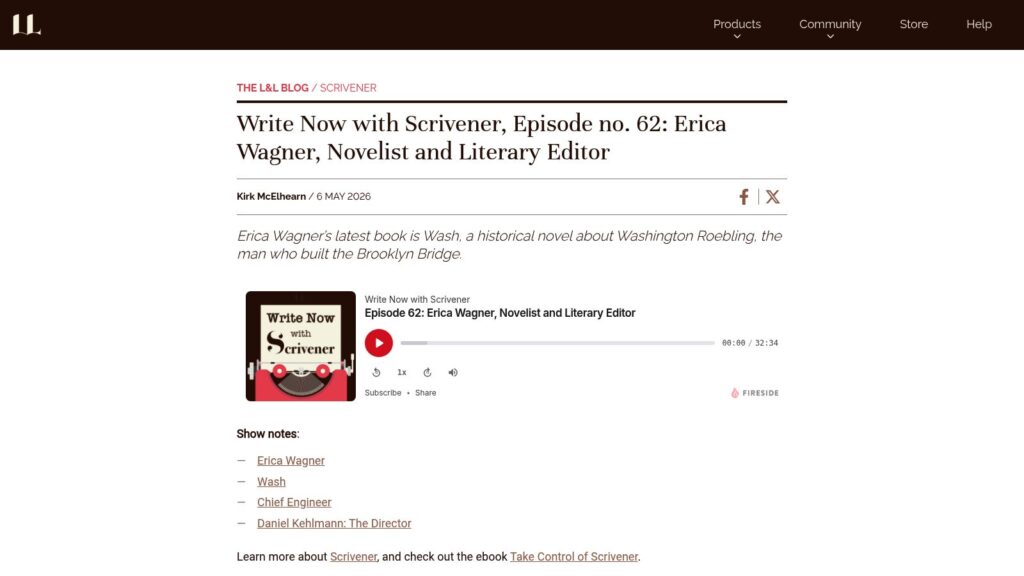
Write Now with Scrivener, Episode No. 62: Erica Wagner, Novelist and Literary Editor

Erica Wagner’s latest book, Wash, is a historical novel about Washington Roebling, the civil engineer who completed the Brooklyn Bridge after his father's death. Drawing from her earlier nonfiction biography Chief Engineer, she employs a modernist, non-chronological narrative to explore Roebling's life and relationships, using the Scrivener software extensively to organize her research and writing.

https://www.literatureandlatte.com/blog/write-now-with-scrivener-episode-no-62-erica-wagner-novelist-and-literary-editor

How Using an External Keyboard with Scrivener for iPad or iPhone Gives You Power-Ups

Using Scrivener on an iPad or iPhone with an external keyboard significantly improves the writing experience by providing more screen space, better cursor control, access to keyboard shortcuts, customizable extended keyboard rows, and enhanced scriptwriting capabilities. Though Apple’s keyboards are premium-priced, they offer seamless integration and protective cases, while other brands offer more affordable alternatives. Overall, pairing an external keyboard with mobile devices makes writing more comfortable and productive, especially for extended work sessions.

https://www.literatureandlatte.com/blog/how-using-an-external-keyboard-with-scrivener-for-ipad-or-iphone-gives-you-power-ups

How to Write a Novel Synopsis

After completing a novel, writers must create a synopsis—a concise, spoiler-filled summary of the story's main characters, plot points, and resolution—formatted in third person, present tense, and typically 500 to 1,000 words long. This synopsis is crucial for agents and editors to understand the novel's structure and character development and is included alongside a query letter and excerpt when submitting work for publication. Writers can develop their synopsis from their novel outline or chapter summaries, ensuring it clearly presents the narrative arc and concludes with the story's ending.

https://www.literatureandlatte.com/blog/how-to-write-a-novel-synopsis

Save Time With the Extended Keyboard Row in Scrivener for iPad and iPhone

Scrivener for iPad and iPhone includes an extended keyboard row that provides easy access to punctuation, formatting, and navigation keys, addressing the limitations of small screens and touch interfaces. This customizable feature enhances writing efficiency by allowing users to quickly switch between sets of keys for special characters, navigation, and formatting, with options to hide the keyboard row if desired.

https://www.literatureandlatte.com/blog/save-time-with-the-extended-keyboard-row-in-scrivener-for-ipad-and-iphone

How to Use Scrivener for Writing Non-Fiction

Scrivener offers powerful features ideal for writing non-fiction books, including specialized templates, flexible organizational tools like the Binder, Corkboard, and Outliner, and a Research folder to store diverse reference materials. It supports footnotes, comments, and annotations, and its flexible compiling options allow writers to produce well-structured manuscripts efficiently, making it a popular choice among non-fiction authors such as biographers, historians, and science writers.

https://www.literatureandlatte.com/blog/how-to-use-scrivener-for-writing-non-fiction

How To End a Story: The 6 Ways All Stories End

The article discusses six common types of story endings—resolved, open, twist, circular, tragic, and cliffhanger—highlighting how each serves different narrative purposes and genres. It emphasizes the importance of choosing an ending that fits the story’s emotional impact, ensuring plot points are resolved or intentionally left open for interpretation, and refining the ending through revision for a satisfying conclusion.

https://www.literatureandlatte.com/blog/how-to-end-a-story-the-6-ways-all-stories-end

Character Development Exercises

The article emphasizes that creating memorable fictional characters requires moving beyond basic descriptions to exploring their psychology through practical exercises. It offers five character development activities—such as writing them under pressure, describing their private spaces, interviewing them, writing them against type, and showing a shared event from multiple perspectives—that help writers deepen their characters’ complexity and realism. These exercises aim to produce a richer understanding that informs more authentic and emotionally precise writing.

https://www.literatureandlatte.com/blog/character-development-exercises

What Is Exposition in Literature? Definition, Tips, and Examples

Exposition in literature provides essential background information like character history, world-building, and prior events, enabling readers to understand the story. Effective exposition avoids overwhelming info-dumps by integrating details naturally through dialogue, conflict, and timing, as exemplified in works like The Great Gatsby, The Lord of the Rings, and The Hunger Games.

https://www.literatureandlatte.com/blog/what-is-exposition-in-literature-definition-tips-and-examples

Scroll to Top