critique

AI-slop , GrantaGate and Bad Writing

The article “AI-slop, GrantaGate and Bad Writing” by Tuhin Chakrabarty discusses concerns about the decline in writing quality, attributing part of the issue to the overreliance on AI-generated content and the controversy surrounding the GrantaGate incident. Chakrabarty emphasizes the importance of maintaining authentic, thoughtful writing in an era increasingly influenced by artificial intelligence.

https://tuhinchakrabarty.substack.com/p/ai-slop-grantagate-and-bad-writing

I Won’t Help Train AI – Word on Fire

In the article “I Won’t Help Train AI,” Christopher Hazell shares his personal decision to decline a lucrative opportunity to train AI in creating narrative art such as fiction and scripts. He argues that while AI can assist with mundane tasks, the creation of authentic art requires human experience, free will, and the capacity for sacrificial love, which AI cannot replicate; thus, embracing AI-generated art risks dehumanizing culture by replacing genuine human communion with simulations.

https://www.wordonfire.org/articles/i-wont-help-train-ai/

AI Is Replacing Creativity with ‘Average’

AI-generated content has rapidly increased across the internet, producing technically accurate and well-structured articles that often lack original perspective or distinct voice. While AI excels at recognizing patterns and generating statistically probable content, this leads to a convergence toward average ideas, reducing novelty and cultural friction essential for innovation and creativity.

https://www.fastcompany.com/91530169/ai-is-replacing-creativity-with-average

It’s Getting Harder to Spot AI in Contemporary Publishing. And That’s Very, Very Bad.

Maris Kreizman discusses the challenges the publishing industry faces in detecting AI-generated text amid the growing sophistication of large language models and the flawed nature of AI detection tools. She argues that the core issue lies in overworked editors and a corporate culture prioritizing quantity over quality, emphasizing that giving editors more time and resources to carefully edit is essential to maintaining the integrity and care of published works.

https://lithub.com/its-getting-harder-to-spot-ai-in-contemporary-publishing-and-thats-very-very-bad/

I Quit. The Clankers Won.

In this blog post, the author argues against the growing pessimism that blogging and creative coding are obsolete due to the rise of AI and big tech dominance. They emphasize that now is more important than ever to blog and share authentic, human voices, resisting the dehumanizing effects of AI-driven content and corporate control, and to support the open, indie web as a space for genuine creativity and conversation.

https://dbushell.com/2026/04/01/i-quit-the-clankers-won/

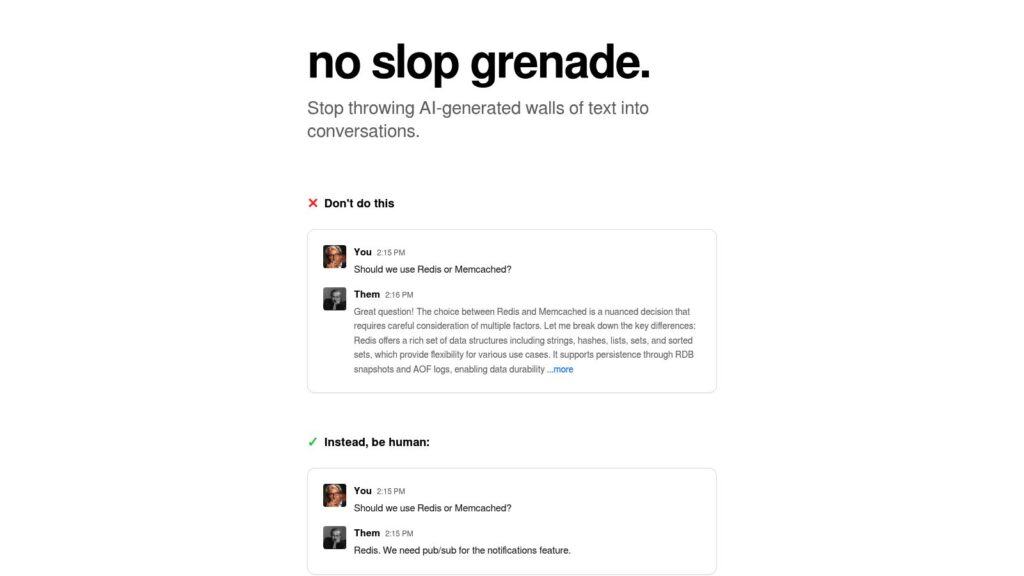
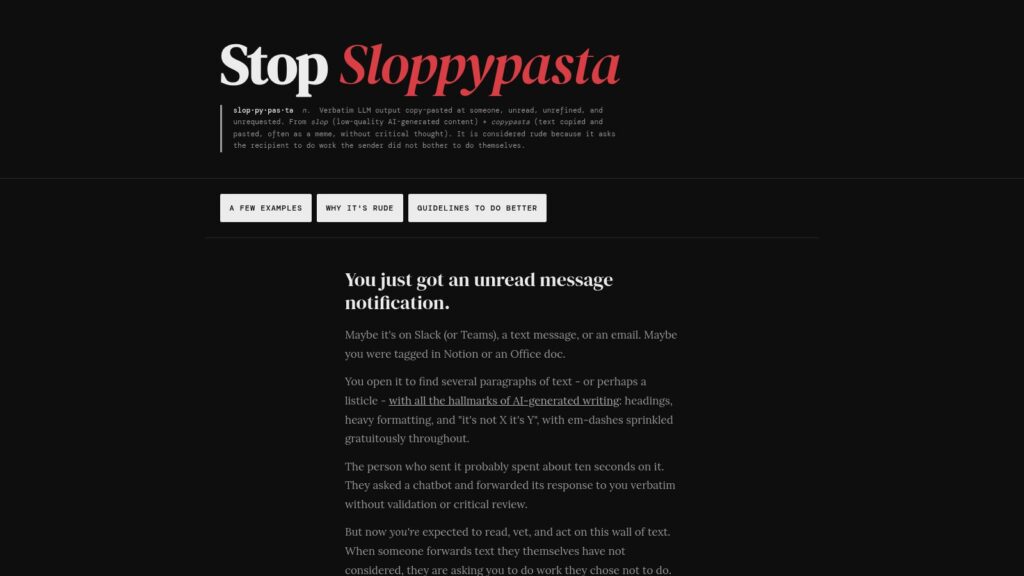
Stop Sloppypasta: Don’t Paste Raw LLM Output at People

Stop Sloppypasta highlights the issue of sharing unrefined, verbatim AI-generated text—termed “sloppypasta”—which is considered rude because it forces recipients to invest effort in reading, verifying, and filtering content the sender did not review or personalize. The site advocates for responsible AI use by encouraging users to read, verify, distill, disclose AI assistance, and only share AI output when requested, to maintain trust and reduce effort asymmetry in communication.

https://stopsloppypasta.ai/en/

LLMs Are Antithetical to Writing and Humanity

LLMs undermine writing and human experience, diminishing critical thought and complicating progress narratives. They often encourage easy, lazy habits over meaningful engagement and creativity. While they can assist some, their broader impact on writing and learning is largely negative. True progress requires critical engagement, understanding the complexities of issues, and resisting superficial solutions. Individuals must seek personal responsibility and constructive paths forward, promoting genuine communication and thought, and rejecting the AI-driven mediocrity that risks diluting human expression.

https://theprogressnetwork.org/ai-llms-writing-humanity/

Staff Journalists Sacked and Misleadingly Replaced With AI Writers

UK gaming sites replaced human writers with AI, creating fake authors and content. Clickout Media acquired The Escapist, Videogamer, and Esports Insider, leading to staff layoffs and AI-generated articles. Discontent among remaining staff is high regarding AI's implications for journalism, highlighted by a controversial AI review on Metacritic, which was removed due to authenticity concerns.

https://pressgazette.co.uk/news/staff-journalists-sacked-and-misleadingly-replaced-with-ai-writers/

Pluralistic: No One Wants to Read Your AI Slop (02 Mar 2026)

AI chat logs are often uninteresting to others; sharing them is intrusive. Generating responses from AI without understanding the context is inadequate and burdens others for explanations. Effective dialogue requires genuine comprehension, not AI-generated outputs. Strangers aren't obligated to review unverified AI content. Seek knowledge before debating; AI can't replace human understanding and insight.

https://pluralistic.net/2026/03/02/nonconsensual-slopping/

Making a Literary Future With Artificial Intelligence

LARB discusses AI's impact on literature through a panel of writers and researchers. They address the mixed feelings toward large language models (LLMs), emphasizing the technology's effects on writing and ethics. Authors argue for creative access to AI and caution against corporate control, advocating for diverse and unique AI models. They explore how LLMs fit into literary history and propose ethical considerations for integrating AI in literary creation. Overall, the conversation aims to navigate AI's role in shaping future literature.

https://lareviewofbooks.org/article/artificial-intelligence-literary-future-chatgpt-large-language-model/

Scroll to Top