art

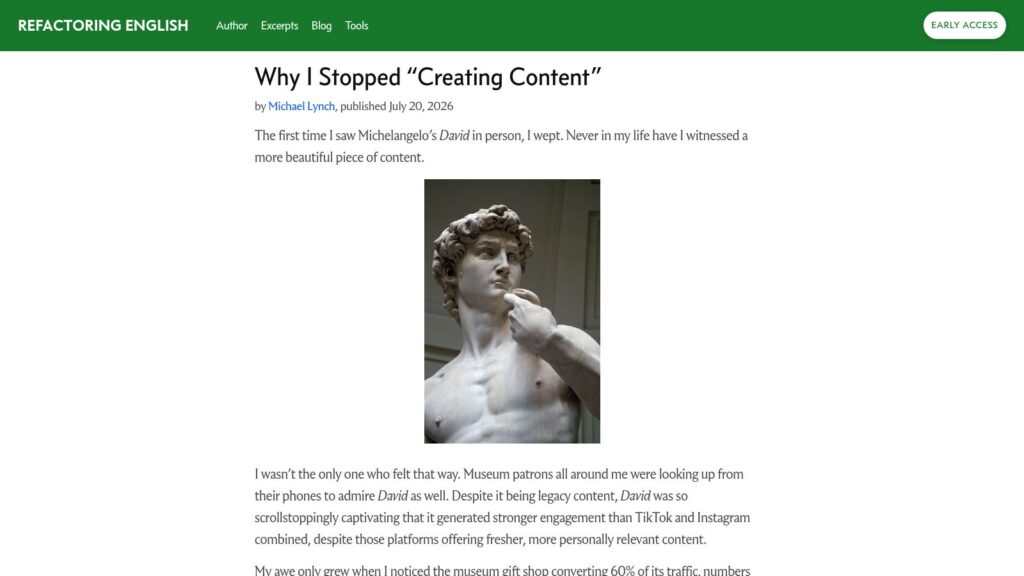
Why I Stopped “Creating Content”

Michael Lynch reflects on his decision to stop describing his creative work as “content,” critiquing how the term, popularized by business jargon, reduces diverse creative expressions to commodified assets like “traffic” and “engagement.” Instead, he advocates for using more precise, human-centered language—calling his audience “readers” and his work a “blog” or “book”—to foster a more authentic connection and mindset about creative practice. This conscious shift in terminology encourages creators to choose words that better reflect their unique roles and the value of their work.

https://refactoringenglish.com/blog/why-i-stopped-creating-content/

A Plea for Poetry in the Age of AI

In “A plea for poetry in the age of AI,” Sophia Yvonne Hall argues that poetry is a vital form of human creativity that resists the homogenizing effects of AI, which tends to prioritize polished and formulaic outputs over originality and emotional depth. She urges readers to embrace the imperfect, messy, and uncertain nature of poetry as a way to preserve authentic creative expression that AI cannot replicate.

https://www.oxfordstudent.com/2026/05/10/a-plea-for-poetry-in-the-age-of-ai/

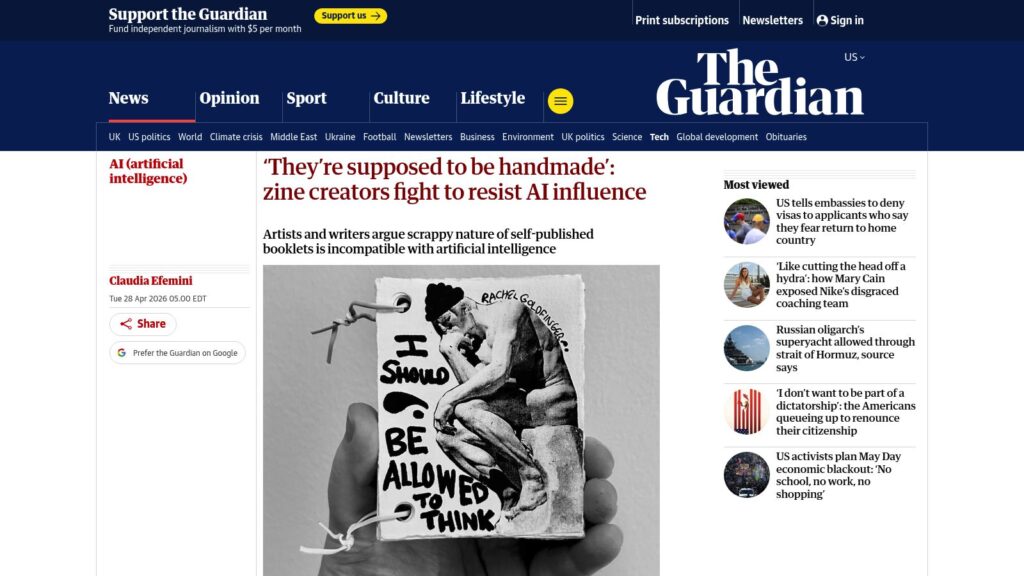
‘They’re Supposed to Be Handmade’: Zine Creators Fight to Resist AI Influence

Zine creators, rooted in a tradition of handmade, self-published booklets tied to cultural movements, are increasingly resisting the influence of artificial intelligence (AI) in their art form, viewing AI as incompatible with the scrappy, personal nature of zines. While some artists experiment with AI for efficiency or artistic experimentation, many, including creators of anti-AI zines, argue that AI diminishes critical thinking and the authenticity of creative work, emphasizing the grassroots, tactile process that defines zine culture.

https://www.theguardian.com/technology/2026/apr/28/zine-creators-fight-to-resist-ai-influence

Scroll to Top