words

English: a vs an

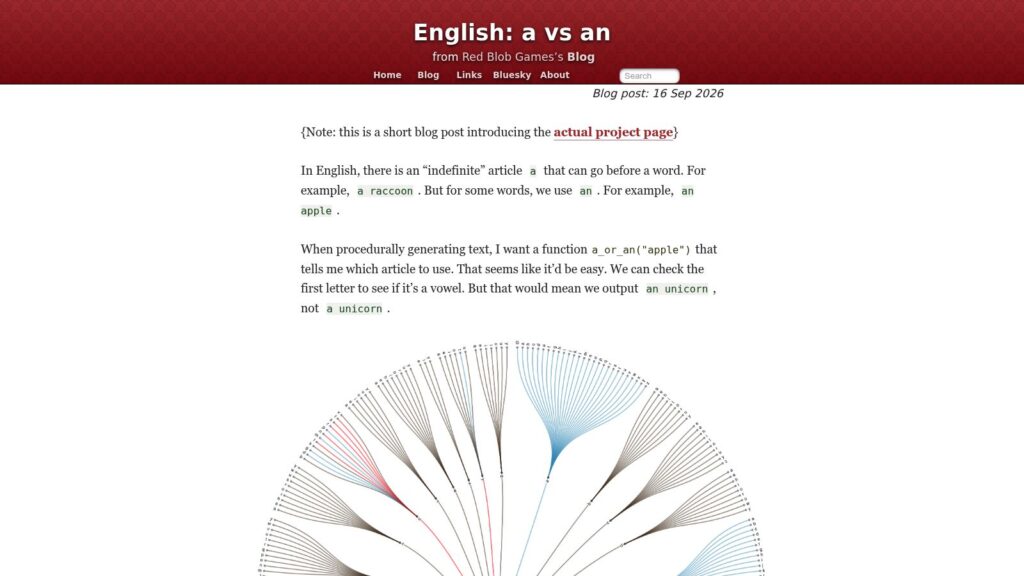
The blog post explains that choosing between the English indefinite articles “a” and “an” depends on the initial sound of the spoken word rather than the first letter of the written word—for instance, “a unicorn” versus “an hour.” The author analyzed a dataset of 32,455 words to identify exceptions and created visualizations, finding that only 129 words required special handling when programmatically determining which article to use for procedural text generation.

https://www.redblobgames.com/blog/2026-09-16-english-a-vs-an/
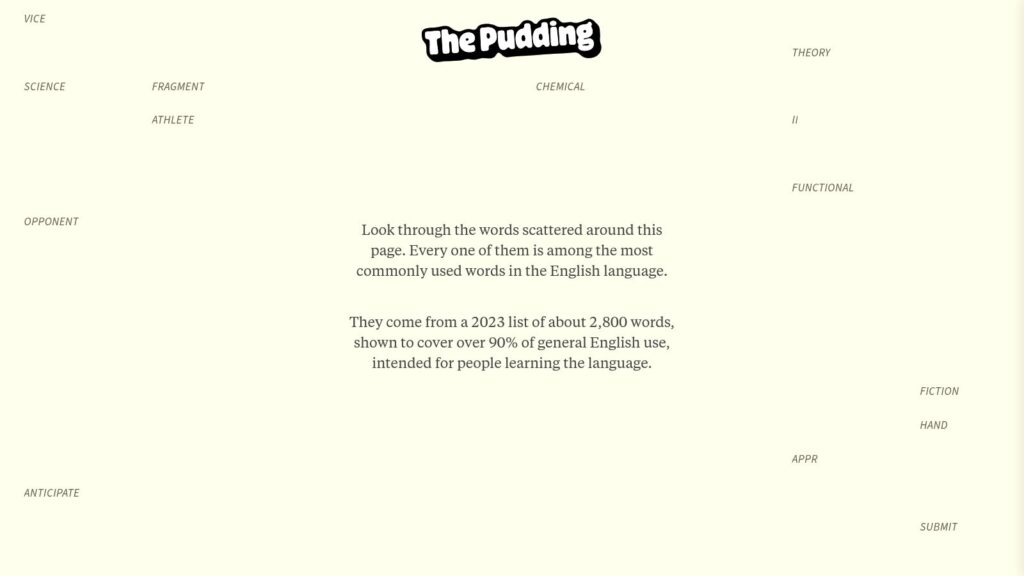
How the Words We Teach English Language Learners Changed

A comparison of the 1953 General Service List and the 2023 New General Service List reveals a significant shift in essential English vocabulary for learners, reflecting changes in daily life and society. The newer list emphasizes more abstract words and concepts related to institutions, systems, and processes, while vocabulary tied to the immediate physical world, hands-on activities, and concrete objects has declined. This transition highlights how language teaching adapts to a world increasingly focused on systemic, global, and intellectual engagement rather than direct, tangible experience.

https://pudding.cool/2026/07/essential-words/

Words With Spaces

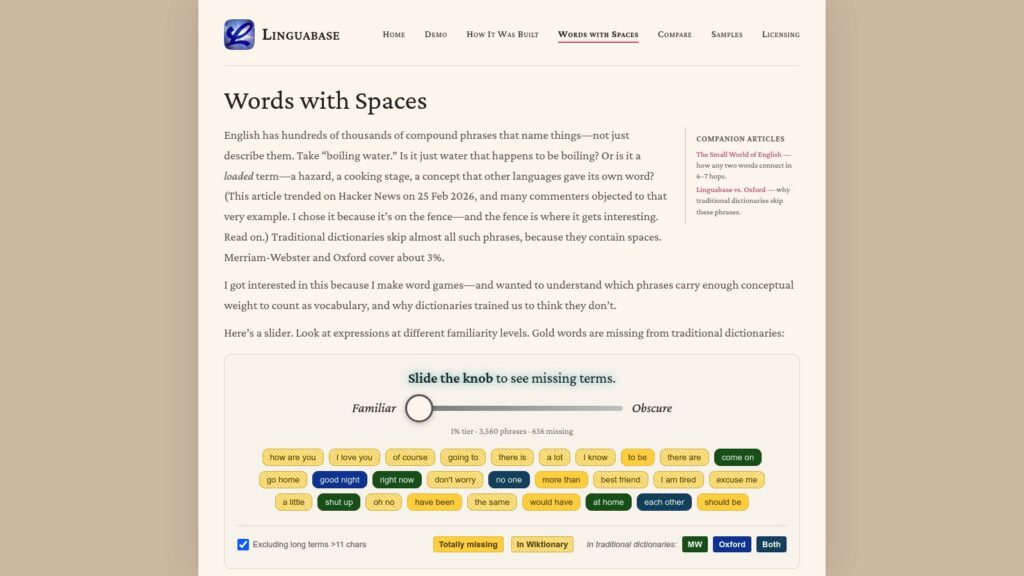
Linguabase explores the significance of compound phrases often overlooked by traditional dictionaries, which cover only a small fraction of multi-word expressions (MWEs). It highlights that English is rich with phrases that have conceptual weight, like “boiling water,” which dictionaries largely ignore. With advancements in AI, such as Claude, a database was generated identifying 774K MWEs, categorizing them by opacity and their usefulness in language and word games. This analysis challenges the perception of vocabulary, revealing a vast array of phrases deserving recognition as words, reshaping insights into how we understand language.

https://www.linguabase.org/words-with-spaces.html

The Strange and Hilarious History of the Word “OK”

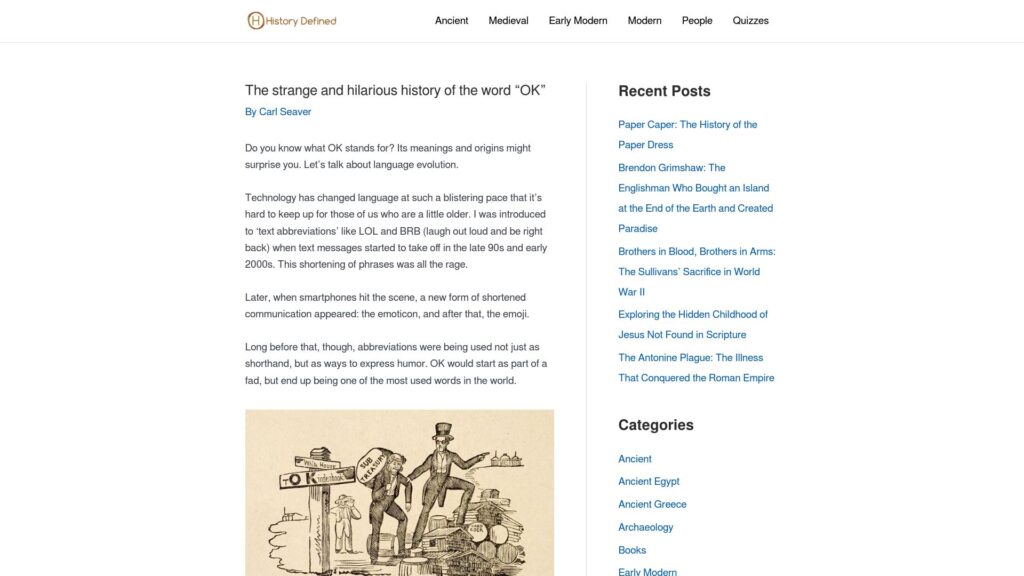
OK's Origin: The term “OK” first appeared in 1839 from the Boston Morning Post as a humorous misspelling of “All Correct” (Oll Korrect). Initially part of a Boston trend of playful misspellings, it gained popularity through the 1840 presidential campaign of Martin Van Buren, nicknamed “Old Kinderhook.” OK spread globally due to its simplicity and ease of adoption in various languages, reinforced by communication technologies like the telegraph, ultimately becoming widely recognized and included in dictionaries.

https://www.historydefined.net/history-of-ok/

Scroll to Top