history

Why I Write

In his essay “Why I Write,” George Orwell reflects on his early desire to become a writer, shaped by loneliness and an ability with words, and identifies four main motives behind writing: sheer egoism, aesthetic enthusiasm, historical impulse, and political purpose. He explains that his own political awareness, especially influenced by events like the Spanish Civil War, led him to combine political purpose with artistic expression, striving to make political writing into an art while acknowledging the struggle and complexity involved in balancing these motives.

https://www.orwellfoundation.com/the-orwell-foundation/orwell/essays-and-other-works/why-i-write/
A Brief History of Lab Notebooks

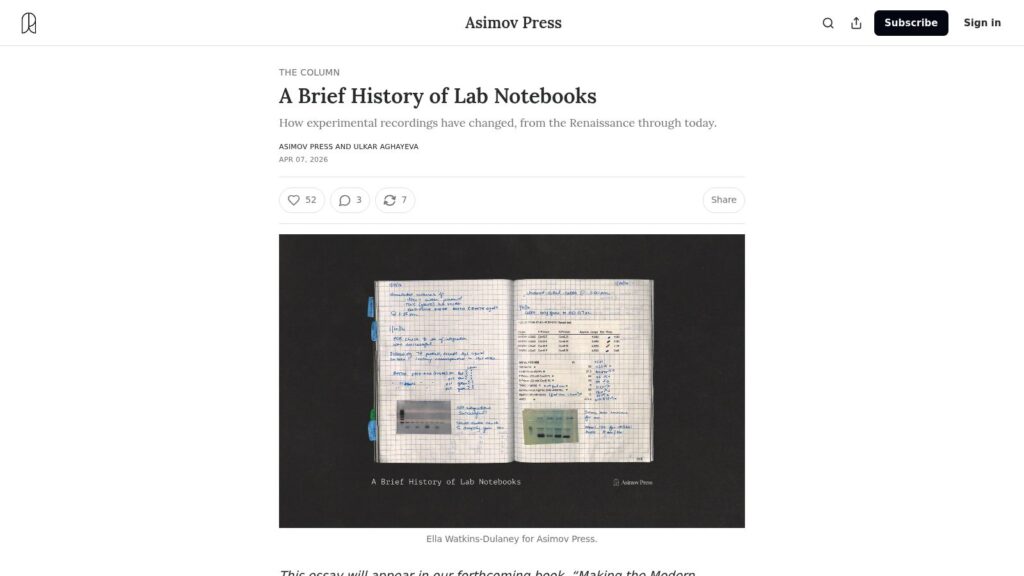
Lab notebooks, a crucial yet often overlooked aspect of scientific research, offer a glimpse into the messy and iterative process of discovery. Originating from Renaissance commonplace books, these notebooks evolved alongside the Scientific Revolution, becoming essential tools for recording and sharing empirical data. While published research papers present a polished narrative, lab notebooks reveal the true nature of scientific inquiry, with its dead ends, false trails, and the relentless pursuit of knowledge.

https://www.asimov.press/p/lab-notebooks

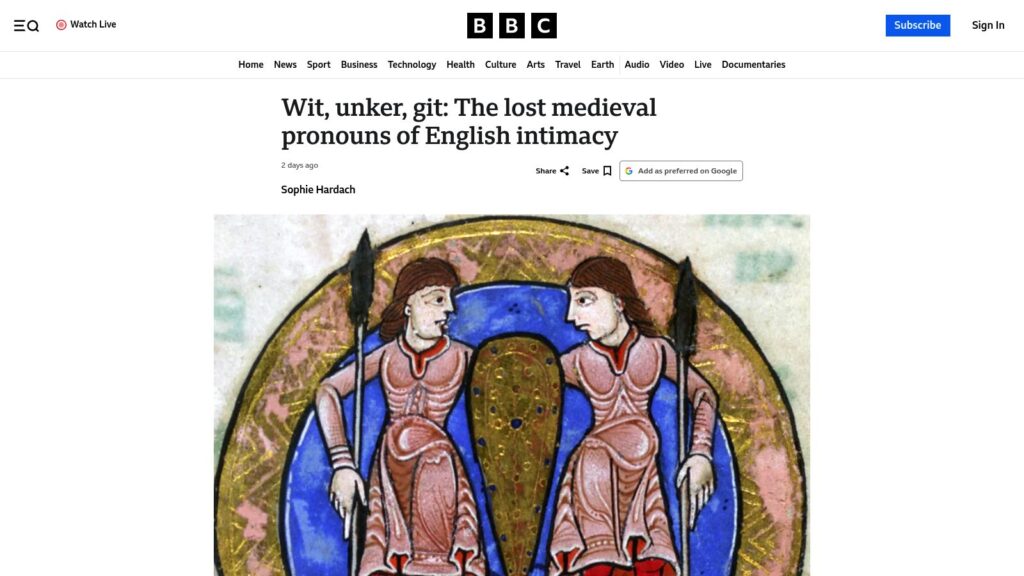
Wit, Unker, Git: The Lost Medieval Pronouns of English Intimacy

Over 1,000 years ago, Old English included a set of now-extinct dual pronouns like “wit” to specifically refer to “we two,” reflecting a unique intimacy between two people. These dual forms disappeared by the 13th century due to social changes and the language's tendency toward simplification, leaving modern English without distinct pronouns for exactly two people. Despite losing these forms, some ancient pronouns have survived, while others like “they” were introduced from Viking influence, showing how English pronouns evolved through history and cultural contact.

https://www.bbc.com/future/article/20260408-the-extinct-english-words-for-just-the-two-of-us

How Far Back in Time Can You Understand English?

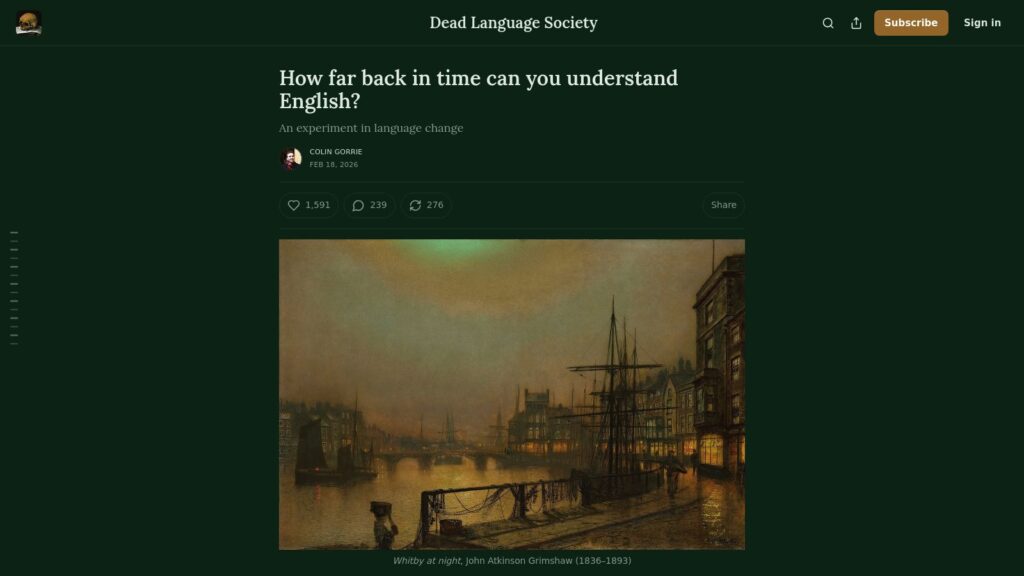
Experiment tracking language evolution shows a fictional travel blogger chronologically writing about a town, Wulfleet. As he writes, English transitions from modern to archaic forms, revealing its historical changes. The narrative illustrates how English's complexity and vocabulary have shifted over centuries. Readers struggle with earlier forms, demonstrating the challenge of understanding English from different eras. The conclusion emphasizes the inevitable evolution of language over time.

https://www.deadlanguagesociety.com/p/how-far-back-in-time-understand-english

The Science of Blunders: Confessions of a Textual Critic

Extreme TLDR:

James Willis, a notable Latinist (1925-2014), focused on textual criticism, emphasizing its importance for understanding Greek and Roman literature. He argued that copying errors are inevitable and that textual criticism helps correct these mistakes, contributing to scholarly editions of classical texts. Through examples, he illustrated that even seemingly correct texts can harbor inaccuracies, stressing the necessity of examining diverse manuscripts to accurately reconstruct ancient writings. Ultimately, he highlighted the challenges and intricacies of ensuring textual fidelity in classical literature.

https://antigonejournal.com/2026/02/science-of-blunders-confessions-textual-critic/

The Strange and Hilarious History of the Word “OK”

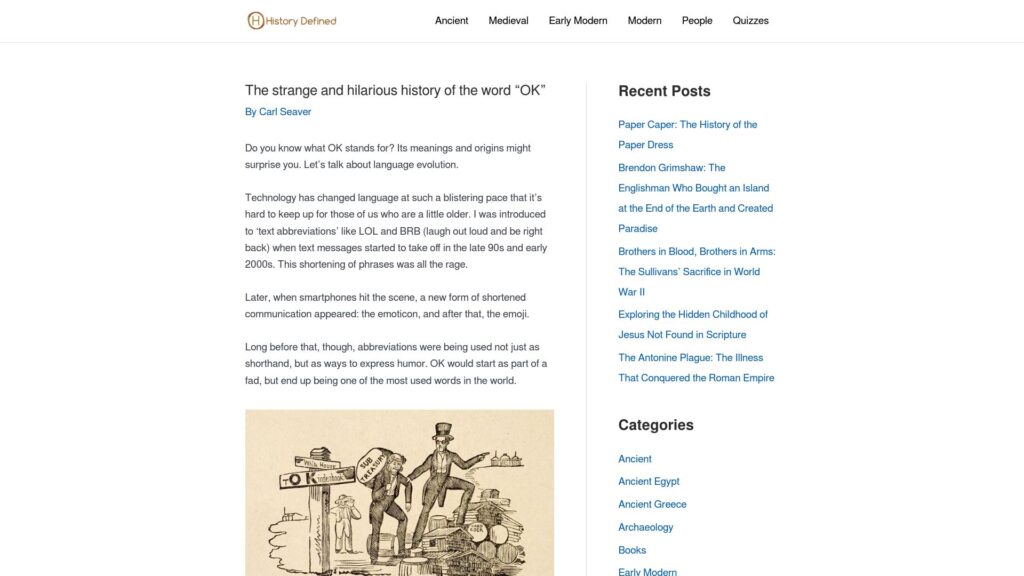
OK's Origin: The term “OK” first appeared in 1839 from the Boston Morning Post as a humorous misspelling of “All Correct” (Oll Korrect). Initially part of a Boston trend of playful misspellings, it gained popularity through the 1840 presidential campaign of Martin Van Buren, nicknamed “Old Kinderhook.” OK spread globally due to its simplicity and ease of adoption in various languages, reinforced by communication technologies like the telegraph, ultimately becoming widely recognized and included in dictionaries.

https://www.historydefined.net/history-of-ok/

Scroll to Top