content creation

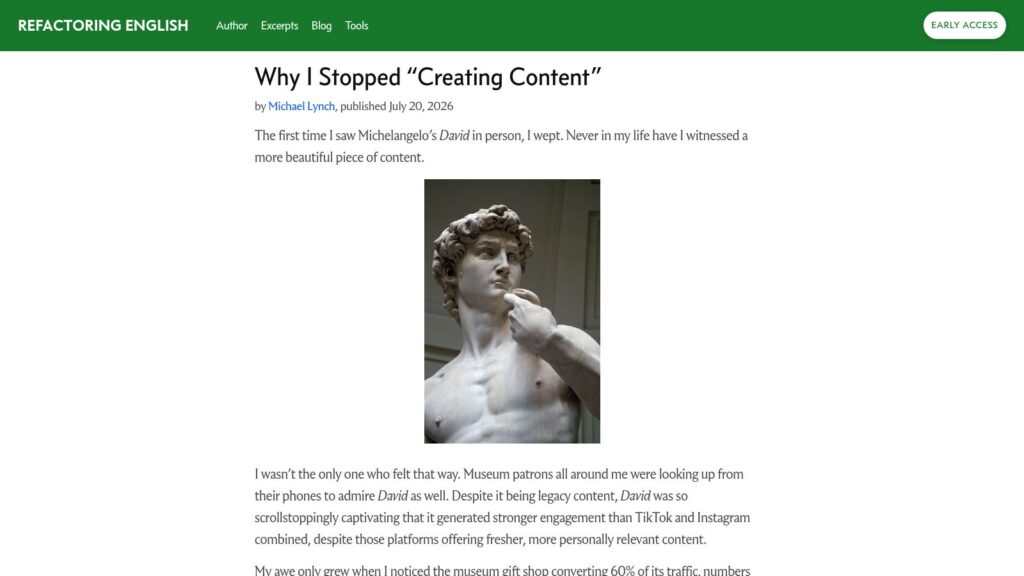
Why I Stopped “Creating Content”

Michael Lynch reflects on his decision to stop describing his creative work as “content,” critiquing how the term, popularized by business jargon, reduces diverse creative expressions to commodified assets like “traffic” and “engagement.” Instead, he advocates for using more precise, human-centered language—calling his audience “readers” and his work a “blog” or “book”—to foster a more authentic connection and mindset about creative practice. This conscious shift in terminology encourages creators to choose words that better reflect their unique roles and the value of their work.

https://refactoringenglish.com/blog/why-i-stopped-creating-content/

Literature Fans Should Welcome AI as a Fellow Wordsmith

Martin Puchner argues that despite strong resistance from many writers, AI should be embraced as a fellow user of language and a creative partner rather than dismissed outright. He highlights how AI challenges traditional notions of human creativity and suggests that literary theories like reader-response criticism and post-structuralism can help us understand AI’s role in language and creativity. Puchner also advocates for integrating AI tools thoughtfully into education and writing practices to enhance thinking and creative processes without undermining essential cognitive skills.

https://aeon.co/essays/literature-fans-should-welcome-ai-as-a-fellow-wordsmith

The 10 Best AI Writing Tools I Recommend as a Pro Writer

The article reviews and recommends the top 10 AI writing tools for creators, small business owners, and marketers, emphasizing their strengths and ideal use cases. It highlights tools like Buffer AI for social media content, Claude for structured and in-depth writing, Jasper for marketing teams, and others, noting that while AI aids in overcoming writer's block and generating ideas, human input remains essential for finalizing content.

https://buffer.com/resources/ai-writing-tools/

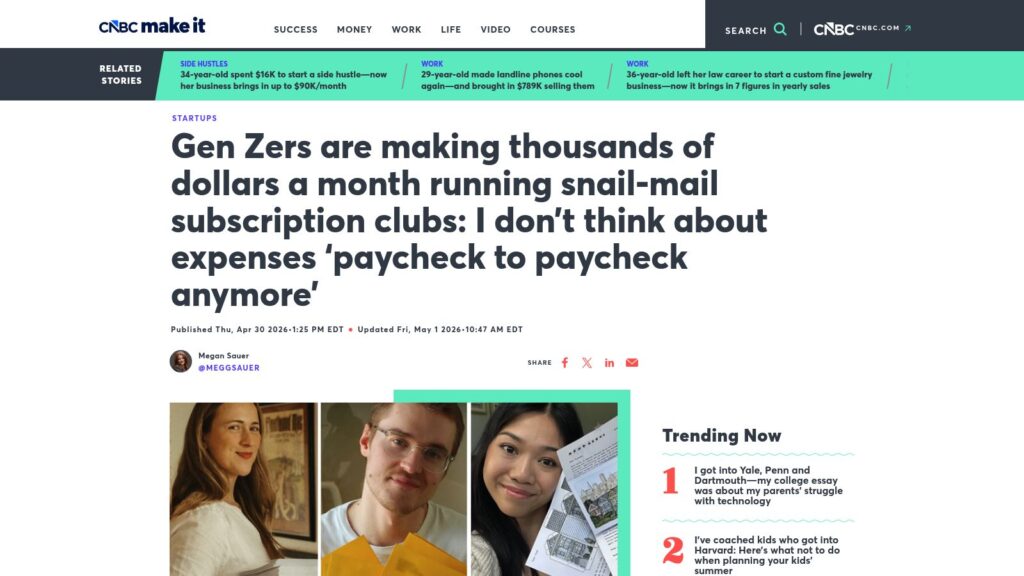
Gen Zers Are Making Thousands of Dollars a Month Running Snail-Mail Subscription Clubs: I Don’t Think About Expenses ‘Paycheck to Paycheck Anymore’

Gen Z entrepreneurs are launching successful snail-mail subscription clubs, sending personalized letters, artwork, and other creative content to thousands of subscribers monthly, earning thousands of dollars in profit. These analog businesses, often promoted via social media, provide financial stability and career confidence for founders like Kiki Klassen and Trinity Shiroma, reflecting a trend towards tactile, offline experiences despite growing digital engagement.

https://www.cnbc.com/2026/04/30/gen-z-snail-mail-subscription-clubs-making-thousands-per-month.html

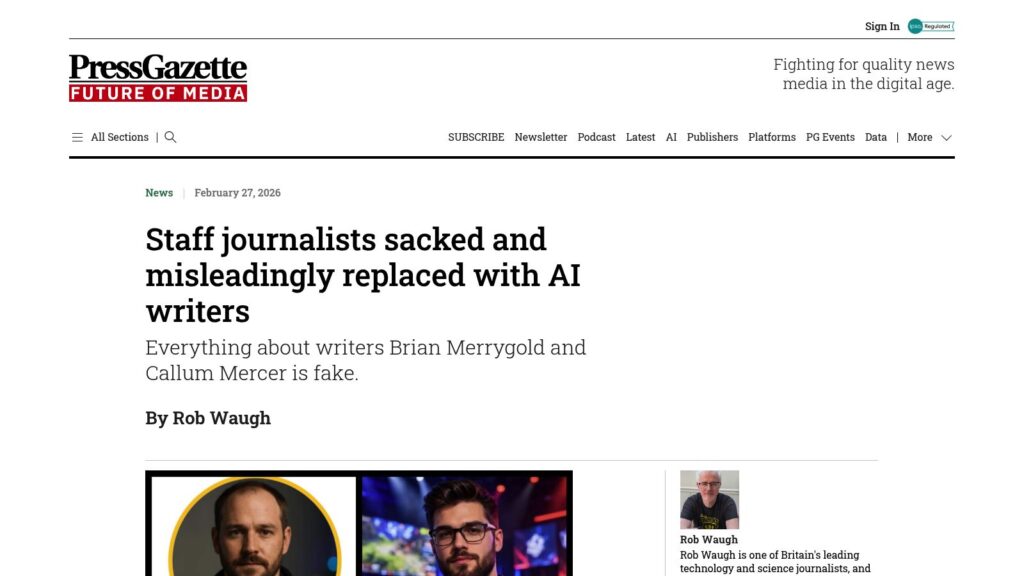
Staff Journalists Sacked and Misleadingly Replaced With AI Writers

UK gaming sites replaced human writers with AI, creating fake authors and content. Clickout Media acquired The Escapist, Videogamer, and Esports Insider, leading to staff layoffs and AI-generated articles. Discontent among remaining staff is high regarding AI's implications for journalism, highlighted by a controversial AI review on Metacritic, which was removed due to authenticity concerns.

https://pressgazette.co.uk/news/staff-journalists-sacked-and-misleadingly-replaced-with-ai-writers/

Are AI-generated Summaries Suitable for Studying and Research?

AI-generated summaries lack academic reliability, often leading to misinformation and overgeneralization, harming learning and research. Human summarization involves critical cognitive skills necessary for retention and understanding, which AI cannot replicate. Ultimately, generating summaries with AI erodes these essential skills and may propagate inaccuracies in academic work. It's advised to rely on human-crafted abstracts or reviews instead.

https://www.tue.nl/en/our-university/library/library-news/24-02-2026-are-ai-generated-summaries-suitable-for-studying-and-research

Scroll to Top