language

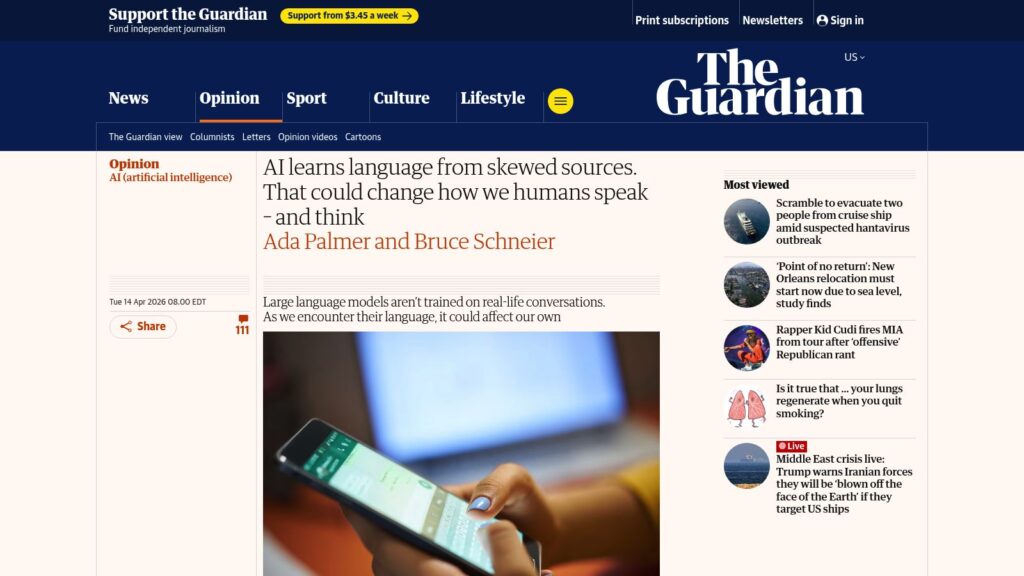
AI Learns Language From Skewed Sources. That Could Change How We Humans Speak – and Think

Large language models are trained primarily on written texts such as books, social media, and scripted dialogue from film and television, rather than the unscripted, everyday speech that makes up most human communication. This skewed training may lead AI-generated language to influence how humans speak and think, potentially narrowing vocabulary, encouraging curt or overly formal speech patterns, and reinforcing biases, thereby affecting our communication and perception of the world in significant but not yet fully understood ways.

https://www.theguardian.com/commentisfree/2026/apr/14/ai-language-human-speech

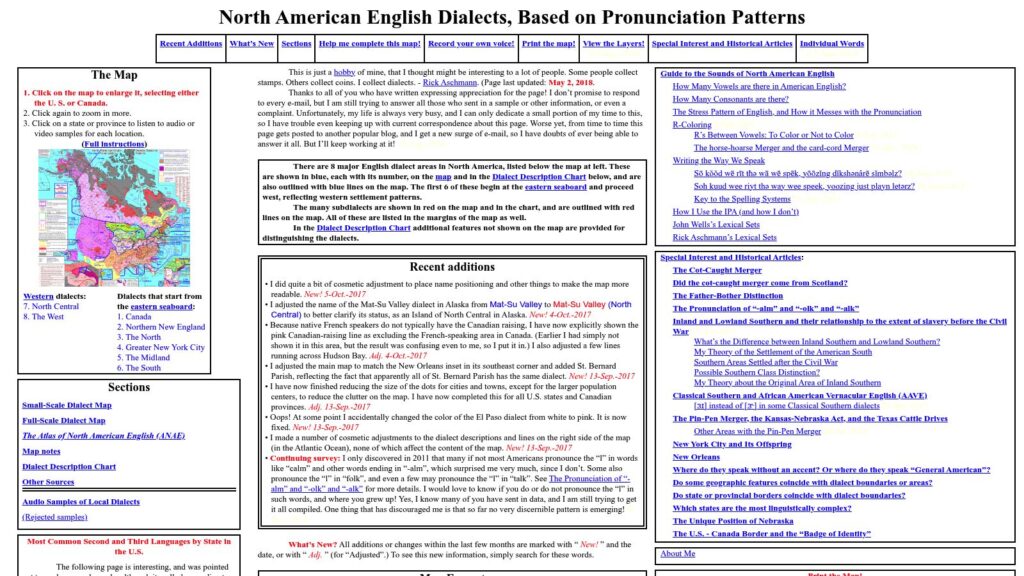
American English Dialects

The article presents a detailed map and analysis of North American English dialects based on pronunciation patterns, incorporating over 900 audio and video samples representing local speech varieties. It draws extensively on data from the Atlas of North American English (ANAE) and includes an interactive, full-scale dialect map that provides clickable samples and detailed descriptions of regional phonological features, such as the pin-pen merger, r-dropping, and vowel fronting. The project encourages community contributions to expand its audio sample collection and offers a comprehensive dialect description chart and phonemic pronunciation guide to assist with understanding regional differences.

https://aschmann.net/AmEng/

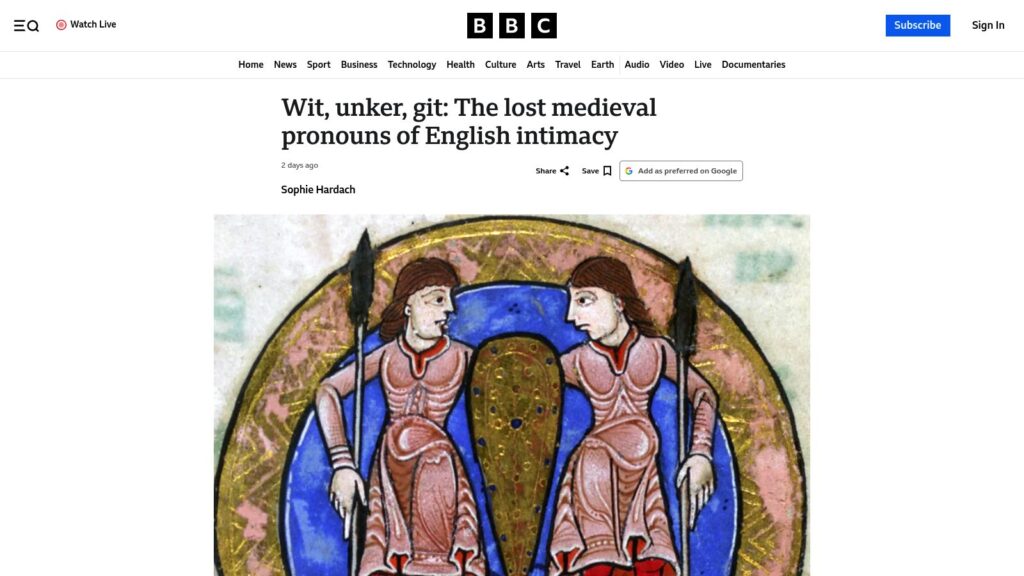
Wit, Unker, Git: The Lost Medieval Pronouns of English Intimacy

Over 1,000 years ago, Old English included a set of now-extinct dual pronouns like “wit” to specifically refer to “we two,” reflecting a unique intimacy between two people. These dual forms disappeared by the 13th century due to social changes and the language's tendency toward simplification, leaving modern English without distinct pronouns for exactly two people. Despite losing these forms, some ancient pronouns have survived, while others like “they” were introduced from Viking influence, showing how English pronouns evolved through history and cultural contact.

https://www.bbc.com/future/article/20260408-the-extinct-english-words-for-just-the-two-of-us

French E, È, É, Ê, Ë – What’s the Difference?

The French letter “e” can be pronounced in several ways, including closed e (/e/), open e (/ɛ/), schwa (/ə/), or be silent, and its pronunciation can change depending on diacritical marks. The accents ë, è, é, and ê indicate specific pronunciations: ë signals an open e in vowel groups, è denotes an open e to prevent it being silent or reduced, é indicates a closed e sound, and ê shows an open e often linked historically to a lost letter, typically “s”.

https://jakubmarian.com/french-e-e-e-e-e-whats-the-difference/

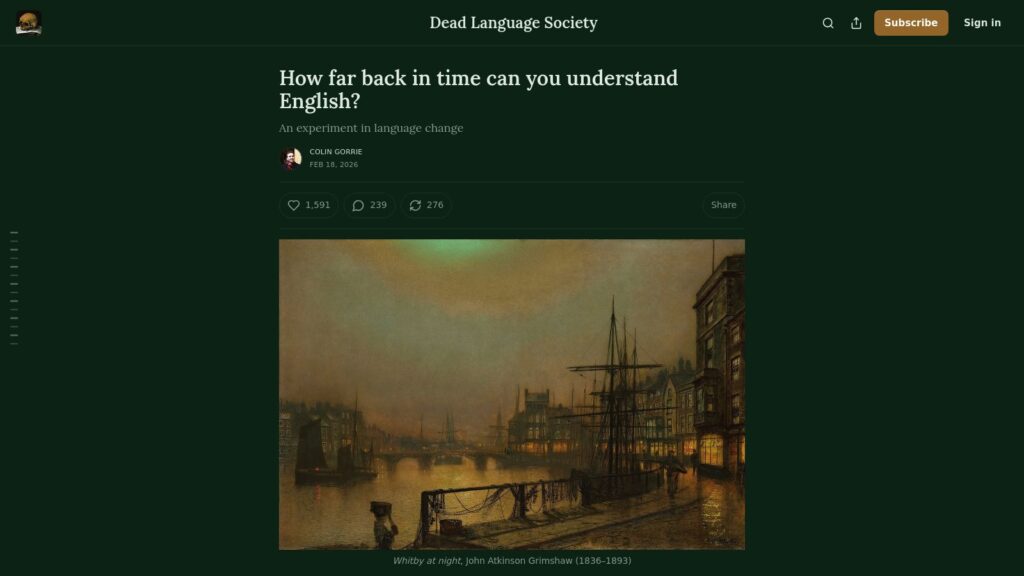
How Far Back in Time Can You Understand English?

Experiment tracking language evolution shows a fictional travel blogger chronologically writing about a town, Wulfleet. As he writes, English transitions from modern to archaic forms, revealing its historical changes. The narrative illustrates how English's complexity and vocabulary have shifted over centuries. Readers struggle with earlier forms, demonstrating the challenge of understanding English from different eras. The conclusion emphasizes the inevitable evolution of language over time.

https://www.deadlanguagesociety.com/p/how-far-back-in-time-understand-english

Scroll to Top