productivity

The Productive Writing Routines of Haruki Murakami, Stephen King, and Virginia Woolf, Explained

The article explores the disciplined and unique writing routines of Haruki Murakami, Stephen King, and Virginia Woolf, highlighting how their structured habits contribute to their prolific output. Murakami combines early morning writing sessions with long-distance running, King employs a routine described as “self-hypnosis,” and Woolf balanced her fiction with regular literary criticism while maintaining a daily diary, emphasizing the importance of a dedicated writing space.

https://www.openculture.com/2026/04/the-productive-writing-routines-of-haruki-murakami-stephen-king-and-virginia-woolf-explained.html

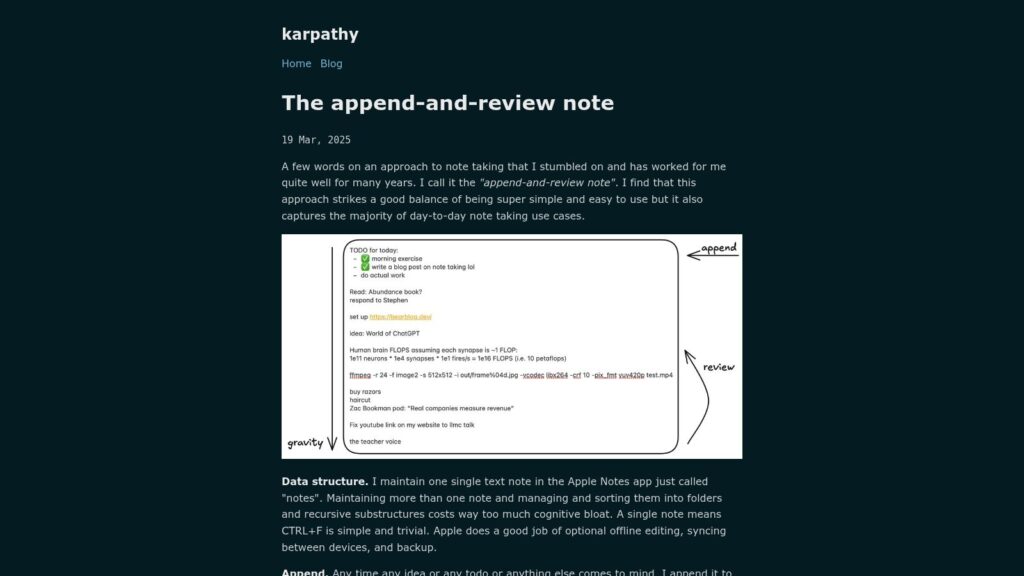
The Append-and-Review Note

Andrej Karpathy describes his “append-and-review note” approach to note-taking, where he maintains a single, continuously appended text note in Apple Notes to capture ideas, todos, and thoughts without organizing them into folders or tags, except for minimal categorization for ease of search. Periodically, he reviews the note by skimming and elevating important items back to the top, finding this simple system effective for managing day-to-day notes while allowing old ideas to resurface or fade naturally.

https://karpathy.bearblog.dev/the-append-and-review-note/

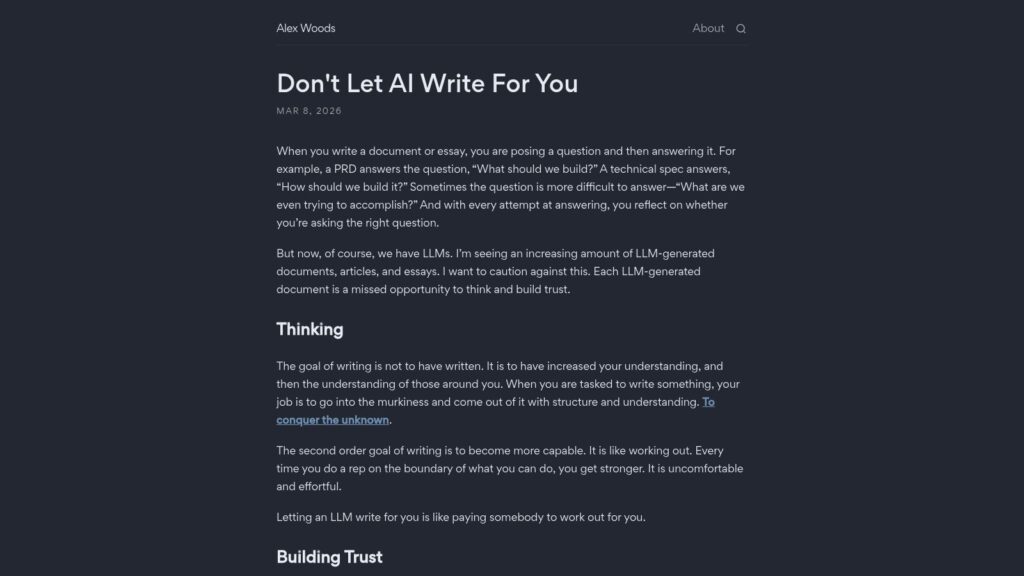
Don’t Let AI Write For You

Alex Woods argues that relying on large language models (LLMs) to write documents or essays undermines the crucial thinking process and opportunity to build trust through authentic engagement with ideas. While LLMs can aid research, idea generation, and transcription, letting them write for you weakens credibility and hampers personal growth in understanding and communication skills.

https://alexhwoods.com/dont-let-ai-write-for-you/

Take Better Notes, By Hand

Brian Schrader discusses his four-part system for taking and organizing research notes, emphasizing the effectiveness of traditional paper notebooks despite their limitations. He outlines practical techniques such as dating every page, numbering pages, maintaining an index, and writing only on the right-hand pages while using the left for follow-up thoughts, which together enhance recall, engagement, and the ability to find notes later.

https://brianschrader.com/archive/take-better-notes-by-hand/

Approaches to Writing Two-sentence Journal Entries

User describes their two-sentence journal method's popularity and shares tips on writing entries. They cover three techniques: using scrap paper for quick thoughts, revising notes in Google Keep for convenience, and writing directly in the journal on busy days. The user details the formats for their analog and digital journals for organization and legibility. They encourage readers to adapt their methods to suit personal preferences.

https://alexanderbjoy.com/two-sentence-journal-approaches/

Allow Me to Introduce the Two-sentence Journal

User struggled with journaling due to perfectionism, resulting in burnout. After experimenting with various methods, they found success with a two-sentence journal inspired by the game Thousand Year Old Vampire. This approach is enjoyable, requires minimal effort, promotes reflection, ensures no day feels wasted, and often creates narrative structures. The constraints of two sentences enhance writing quality and reveal deeper connections. The user encourages others to try this format and share their entries.

https://alexanderbjoy.com/two-sentence-journal/

Monkeytype

Monkeytype is a minimalist, customizable typing test platform launched in May 2020. It offers various test modes, an account system for tracking progress, and user-configurable features like themes and sounds. The site has seen over 4.76 billion tests and almost 11 million hours of typing. It provides detailed feedback on typing speed, accuracy, and consistency. The community actively supports development through feedback, donations, and code contributions, with numerous top supporters and contributors recognized.

https://monkeytype.com/

Scroll to Top