admin

What Is an Anachronism? Definition and Examples
TLDR: Anachronism refers to elements that are out of place in time, like modern items in historical settings. It serves various functions in writing, art, and education, and can be intentional (for humor or commentary) or accidental (due to oversight). The four types are parachronisms (past in present), prochronisms (future in past), behavioral (actions inconsistent with time), and false anachronisms (seemingly out-of-place but accurate). Understanding and identifying anachronisms enhance critical thinking and creativity in storytelling, while avoiding them requires thorough research.

https://www.grammarly.com/blog/academic-writing/anachronism/
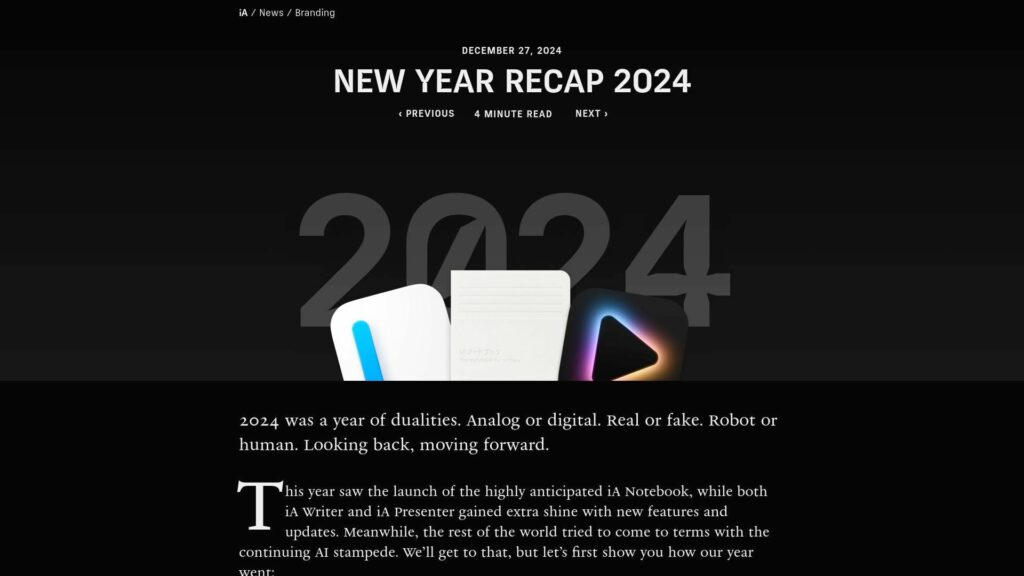
New Year Recap 2024

2024 marked dualities: analog vs. digital, real vs. fake. The iA Notebook launched after ten years, selling out quickly, while iA Writer and Presenter received feature updates. Key highlights included iA Presenter’s new Unsplash image integration and web sharing capabilities, plus iA Writer’s redesign for Windows 11 and faster performance. AI tools proliferated, raising concerns over ownership and quality. iA focused on human creativity, providing resources for writing and presentations. The team took a break over the holidays, with plans to continue supporting creativity in 2025.

https://ia.net/topics/new-year-recap-2024

Silent Letters in English: a Guide With Examples

Silent letters in English complicate fluency. They are letters that are part of a word's spelling but not pronounced, differing from other Latin languages. The article discusses their patterns, origins, purposes, and learning tips, noting that they can vary by dialect and contain exceptions. Key patterns include silent ‘k’ before ‘n,’ silent ‘g’ before ‘n,’ silent ‘b’ after ‘m,’ silent ‘p’ in Greek words, and silent ‘h’ in certain Latin-origin words. While 40% of silent letters follow recognizable patterns, many words do not, posing challenges for learners.

https://www.grammarly.com/blog/writing-tips/silent-letters/

Kottke on the Art and Power of Hypertextual Writing

Kottke highlights hypertextual writing's effectiveness, noting a brief NYT editorial packed with links that enhances information density. He points out how hyperlinks add depth to web writing, contrasting it with traditional print writing. The NYT’s approach is seen as a rare, impactful example of online prose. Gruber reflects on the limitations of social media in employing hypertext, which detracts from the richness of web writing.

https://daringfireball.net/2024/11/kottke_on_the_art_and_power_of_hypertextual_writing

How To Improve Your Microcopy: UX Writing Tips For Non-UX Writers

Extreme TLDR:

Improve microcopy by ensuring it’s role-playable, clear, and concise. Use friendly dialogues, be transparent on sensitive topics, and reflect actions in button labels. Provide clear reasons for actions, avoid explaining UI interactions, and limit each message to one idea. Use relatable examples, avoid negatives, and eliminate jargon. Ensure titles and buttons are understandable without body text, and always lead with important info. Use specific terms consistently and keep error messages straightforward. Aim for a smooth user experience and collaborate with designers for effective microcopy creation.

https://www.smashingmagazine.com/2024/06/how-improve-microcopy-ux-writing-tips-non-ux-writers/

Scroll to Top