Now Available: Write Confidently in 5 New Languages

Grammarly now supports writing in 5 languages (Spanish, French, Portuguese, German, Italian) with grammar corrections and paragraph rewrites, plus inline translation across 19 languages. This feature enhances global collaboration, allowing users to write clearly without switching tools. It's available for all Grammarly plans, requiring no installation. Future updates will include advanced suggestions and integration into Grammarly's AI tools.

https://www.grammarly.com/blog/product/multilingual-support-launch/

How to Create and Work With Poetry Projects in Scrivener

Scrivener is an effective tool for writing, organizing, revising, and compiling poetry collections, featuring a specialized poetry template and various management tools. Users can create a poetry project with a simple template selection, utilize line numbers, and organize their work in the Binder. Revision and editing are streamlined with the snapshot feature for tracking changes. Compiling projects into formats like PDF or .docx is easy, making Scrivener ideal for poets preparing submissions.

https://www.literatureandlatte.com/blog/how-to-create-and-work-with-poetry-projects-in-scrivener

How to Use Bear and MindNode Together

Bear and MindNode, two apps favored by the Bear team, work well together to enhance productivity. MindNode is an intuitive mind-mapping tool that aids brainstorming, while Bear focuses on detailed note-taking. Their integration allows seamless workflow between them, enabling users to visualize big ideas and refine details efficiently. Utilizing both apps together fosters a clear and organized approach to tasks, making projects manageable across devices. Users can brainstorm in MindNode, link Bear notes for references, or import Bear notes into MindNode for visual overviews, enhancing overall project execution.

https://blog.bear.app/2025/09/how-to-use-bear-and-mindnode-together/

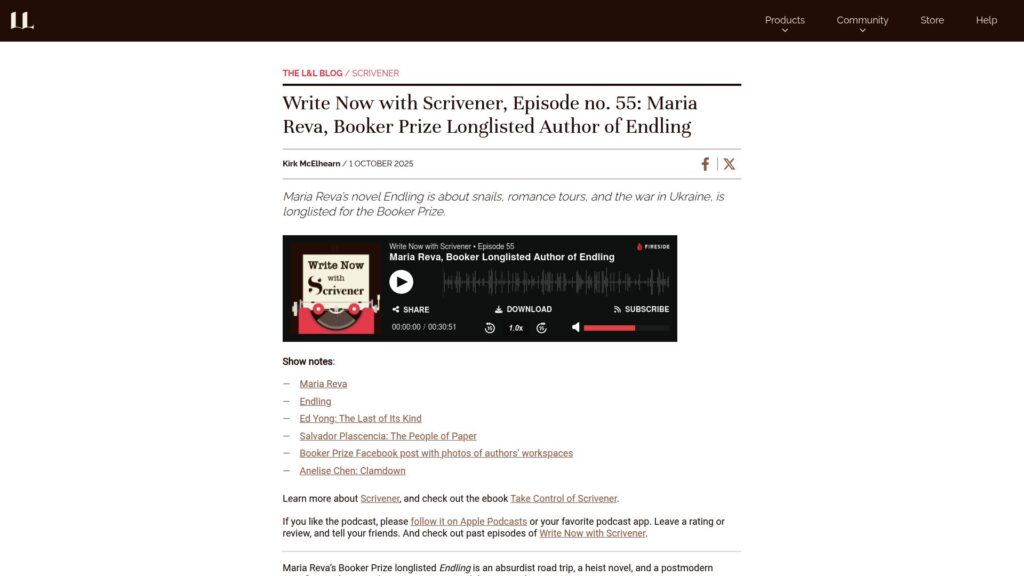
Write Now With Scrivener, Episode No. 54: Tim Queeny, Author of a History of Rope

Tim Queeny released a non-fiction book, Rope: How a Bundle of Twisted Fibers Became the Backbone of Civilization. It explores the origins and significance of rope across various industries and its historical impact, tracing back to 50,000-year-old Neanderthal creations. Tim, a sailor and former editor of Ocean Navigator, utilized Scrivener for his research organization while writing. He condensed his manuscript from 93,000 to 75,000 words, omitting a long section on Hitchcock's Rope.

https://www.literatureandlatte.com/blog/write-now-with-scrivener-episode-no-54-tim-queeny-author-of-a-history-of-rope

Grammarly Named to the 2025 Forbes Cloud 100 List

Grammarly ranked 11th on the 2025 Forbes Cloud 100, marking its sixth consecutive year on the list. This recognition highlights its AI innovations and broad user base. The company has built an AI superhighway for seamless integration into various apps, focusing on enhancing user workflows without intrusion. As Grammarly evolves from assistant to AI productivity platform, recent acquisitions of Coda and Superhuman, alongside new AI agents, aim to streamline tasks and improve efficiency. The company emphasizes creating intuitive and trustworthy AI tools, celebrating its Forbes recognition as a milestone in its broader journey towards enhancing user clarity and control.

https://www.grammarly.com/blog/company/forbes-cloud-100-list-2025/

A Presentation App That Works on Your Phone

iA Presenter is a presentation app that enables users to create professional presentations in under 20 minutes on any device, emphasizing simplicity and focus over design selection. Unlike traditional apps, it starts with content, offering responsive black-and-white templates to avoid distractions. Version 1.5 improves mobile usability by simplifying the templating system further and enhancing typography, while an updated Web Sharing feature is forthcoming. Overall, it aims for a clean, efficient experience tailored for modern mobile use.

https://ia.net/topics/a-presentation-app-that-works-on-your-phone

Go Beyond Your Genre: Why Writers Should Read Widely

Authors should read widely across genres to enhance their writing. Stephen King emphasizes reading and writing as essential practices. Writers gain valuable insights by exploring different styles and plots, not just their own genre conventions. Keeping up with market trends and classic literature deepens understanding and inspires creativity. Broad reading habits improve vocabulary and narrative techniques, while engaging with various genres and forms—like poetry and non-fiction—broadens perspective and enriches storytelling.

https://www.literatureandlatte.com/blog/go-beyond-your-genre-why-writers-should-read-widely

Do Blogs Need to Be so Lonely?

Blogs can feel isolating despite the web's participatory nature. The author envisions group blogging as a remedy, recalling successful collaborative sites like Fray.com and Afterdinner from the '90s that fostered community input. Modern blogging is hindered by an individualistic mindset and dominance of large platforms. Despite technological advancements enabling effective collaboration, personal blogs often lack communal aspects. The author advocates for collective blogging to revitalize participation and connection among writers.

https://thehistoryoftheweb.com/do-blogs-need-to-be-so-lonely/

Revising Vs. Editing Vs. Proofreading: What’s the Difference?

Revising, editing, and proofreading are distinct stages in writing refinement. Revising focuses on ideas and content clarity, editing enhances language flow and readability, while proofreading corrects surface errors. Writers typically transition through these phases from broader content changes to fine details, ensuring a polished final piece.

https://www.grammarly.com/blog/writing-process/revising-vs-editing-vs-proofreading-whats-the-difference/

Scroll to Top