AI

LLMs Are Antithetical to Writing and Humanity

LLMs undermine writing and human experience, diminishing critical thought and complicating progress narratives. They often encourage easy, lazy habits over meaningful engagement and creativity. While they can assist some, their broader impact on writing and learning is largely negative. True progress requires critical engagement, understanding the complexities of issues, and resisting superficial solutions. Individuals must seek personal responsibility and constructive paths forward, promoting genuine communication and thought, and rejecting the AI-driven mediocrity that risks diluting human expression.

https://theprogressnetwork.org/ai-llms-writing-humanity/

We’re Training Students To Write Worse To Prove They’re Not Robots, And It’s Pushing Them To Use More AI

AI detection tools in education are forcing students to simplify their writing to avoid being flagged as using AI, which ironically leads them to actually use AI for self-defense against false accusations. This “Cobra Effect” damages creativity and penalizes good writing, pushing students toward mediocrity. The approach needs to shift from monitoring to teaching responsible AI use, allowing students to engage in genuine learning rather than navigating a surveillance atmosphere that discourages originality.

https://www.techdirt.com/2026/03/06/were-training-students-to-write-worse-to-prove-theyre-not-robots-and-its-pushing-them-to-use-more-ai/

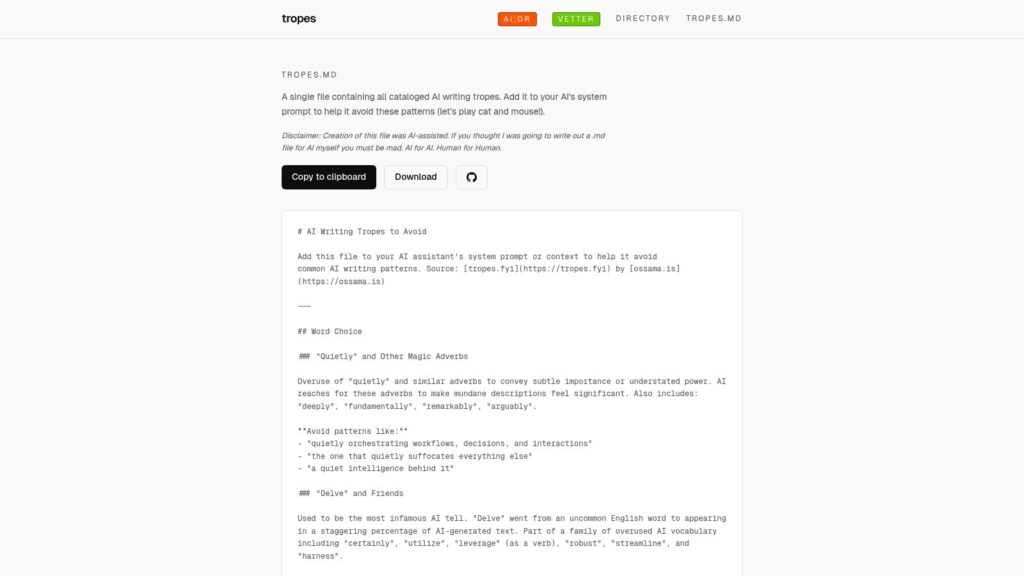
Tropes.md

AI Writing Tropes to Avoid: A guide for improving AI-generated text by identifying and avoiding overused phrases and patterns. Tropes include unnecessary adverbs (e.g., “quietly”), fancy nouns (e.g., “tapestry”), complex sentence structures (e.g., “It's not X — it's Y”), and superficial analyses. Patterns like excessive repetition, filler phrases, and vague attributions should be minimized. Aim for varied, human-like writing to increase authenticity.

https://tropes.fyi/tropes-md

Staff Journalists Sacked and Misleadingly Replaced With AI Writers

UK gaming sites replaced human writers with AI, creating fake authors and content. Clickout Media acquired The Escapist, Videogamer, and Esports Insider, leading to staff layoffs and AI-generated articles. Discontent among remaining staff is high regarding AI's implications for journalism, highlighted by a controversial AI review on Metacritic, which was removed due to authenticity concerns.

https://pressgazette.co.uk/news/staff-journalists-sacked-and-misleadingly-replaced-with-ai-writers/

Pluralistic: No One Wants to Read Your AI Slop (02 Mar 2026)

AI chat logs are often uninteresting to others; sharing them is intrusive. Generating responses from AI without understanding the context is inadequate and burdens others for explanations. Effective dialogue requires genuine comprehension, not AI-generated outputs. Strangers aren't obligated to review unverified AI content. Seek knowledge before debating; AI can't replace human understanding and insight.

https://pluralistic.net/2026/03/02/nonconsensual-slopping/

Making a Literary Future With Artificial Intelligence

LARB discusses AI's impact on literature through a panel of writers and researchers. They address the mixed feelings toward large language models (LLMs), emphasizing the technology's effects on writing and ethics. Authors argue for creative access to AI and caution against corporate control, advocating for diverse and unique AI models. They explore how LLMs fit into literary history and propose ethical considerations for integrating AI in literary creation. Overall, the conversation aims to navigate AI's role in shaping future literature.

https://lareviewofbooks.org/article/artificial-intelligence-literary-future-chatgpt-large-language-model/

Are AI-generated Summaries Suitable for Studying and Research?

AI-generated summaries lack academic reliability, often leading to misinformation and overgeneralization, harming learning and research. Human summarization involves critical cognitive skills necessary for retention and understanding, which AI cannot replicate. Ultimately, generating summaries with AI erodes these essential skills and may propagate inaccuracies in academic work. It's advised to rely on human-crafted abstracts or reviews instead.

https://www.tue.nl/en/our-university/library/library-news/24-02-2026-are-ai-generated-summaries-suitable-for-studying-and-research

AI Taxonomy

The document proposes a taxonomy for describing AI systems based on what they do, rather than the technologies they use. It defines six functional categories: Analytical AI (decides), Semantic AI (understands), Generative AI (creates), Agentic AI (acts), Perceptive AI (senses), and Physical AI (moves). It argues that most real-world products combine multiple categories. The conclusion is that using function-based descriptions improves clarity, communication, and practical understanding of AI capabilities. 

https://dropleaf.app/d/AlXez8scbd

Why AI Writing Is so Generic, Boring, and Dangerous: Semantic Ablation

AI writing suffers from “semantic ablation,” where high-entropy, unique information is eroded during processing. This occurs as models prioritize statistical probability, discarding complex tokens for generic outputs. The article outlines three stages of this process: 1) replacing unconventional metaphors with clichés, 2) diluting specific jargon for accessibility, and 3) forcing logical structures into predictable templates. The result is content that appears polished but lacks depth, leading to a homogenization of thought and expression. Recognizing semantic ablation is essential to preserving meaningful communication.

https://www.theregister.com/2026/02/16/semantic_ablation_ai_writing/

Scroll to Top