admin

A Brief History of Lab Notebooks
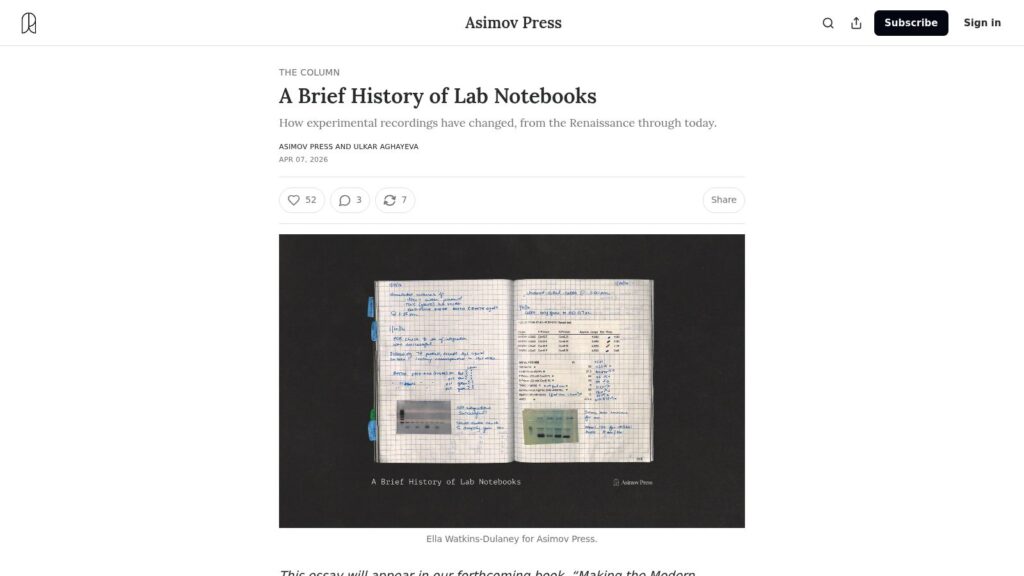
Lab notebooks, a crucial yet often overlooked aspect of scientific research, offer a glimpse into the messy and iterative process of discovery. Originating from Renaissance commonplace books, these notebooks evolved alongside the Scientific Revolution, becoming essential tools for recording and sharing empirical data. While published research papers present a polished narrative, lab notebooks reveal the true nature of scientific inquiry, with its dead ends, false trails, and the relentless pursuit of knowledge.
https://www.asimov.press/p/lab-notebooks

The AI Writing Witchhunt Is Pointless.

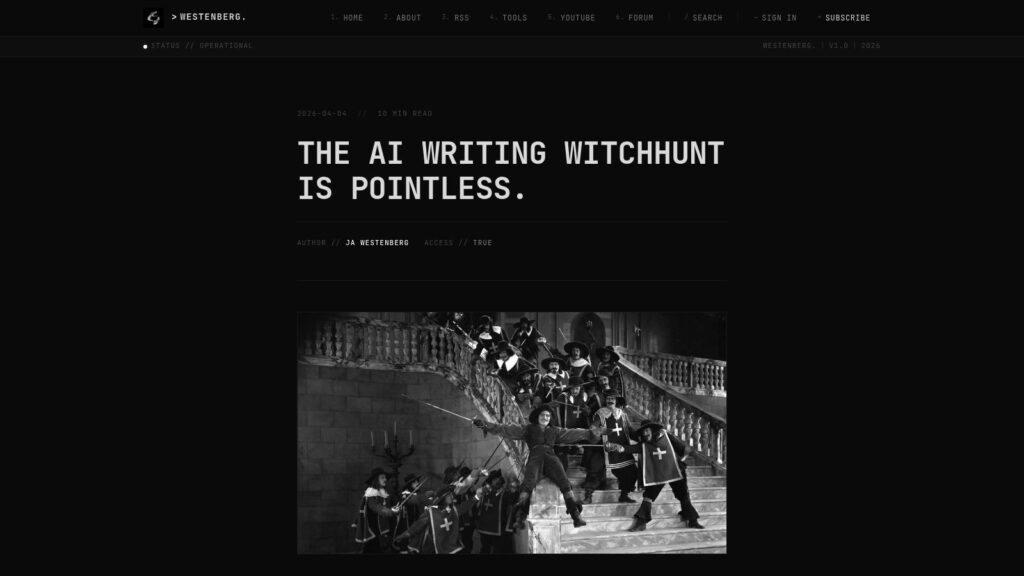
Joan Westenberg argues that the current witchhunt against AI-assisted writing is misguided and harmful, highlighting the unreliable nature of AI detection tools and the unfair career damage suffered by authors like Mia Ballard, whose novel was pulled amid unproven AI-use accusations. She compares this to historical collaborative writing practices, emphasizing that attempts to police AI usage through crowdsourced suspicion and flawed detectors threaten all writers without offering meaningful solutions, calling for more reasoned and evidence-based approaches instead.

https://www.joanwestenberg.com/the-ai-writing-witchhunt-is-pointless/

Gilest.org: AI and the Human Voice

In this article, the author expresses skepticism about AI-generated writing, arguing that AI tends to produce clichéd and derivative text lacking subtlety and the human touch found in effective communication. While AI can draft simple content or even poems, it cannot replicate the nuanced, playful flourishes—“tiny sprinklings of poetry”—that human writers use to engage readers and make text memorable; therefore, human input remains essential to refine AI drafts into truly impactful writing.

https://gilest.org/notes/2026/human-ai/

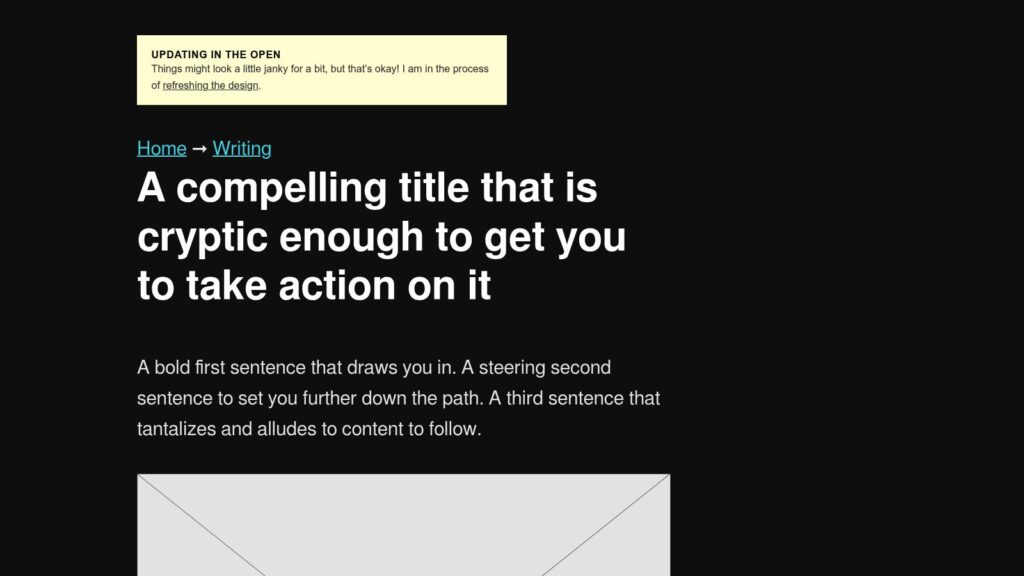
A Compelling Title That Is Cryptic Enough to Get You to Take Action on It

The article outlines a structured approach to writing content that engages readers through compelling titles, clear segmentation with subheadings, and use of formatting like bold text, lists, and code snippets to enhance understanding. It emphasizes progressively deepening the technical detail while maintaining reader interest and concludes by tying the discussed points together to reinforce the main message.

https://ericwbailey.website/published/a-compelling-title-that-is-cryptic-enough-to-get-you-to-take-action-on-it/

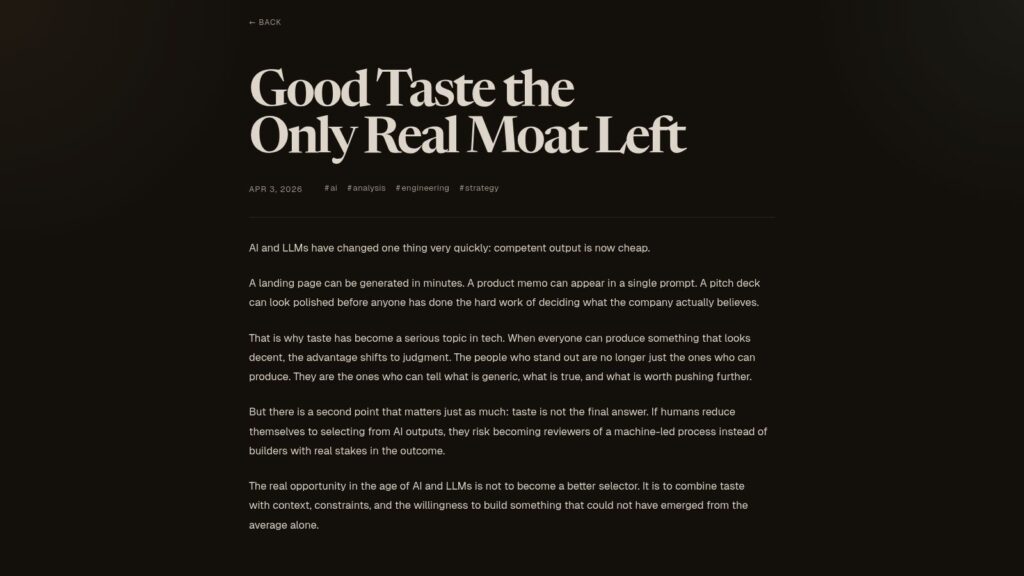
Good Taste the Only Real Moat Left

The article argues that with AI and large language models making competent outputs cheap and abundant, the real competitive advantage has shifted to human judgment, or “taste,” which involves distinguishing what is generic from what is meaningful under uncertainty. However, taste alone is not sufficient; humans must combine it with real-world context, stakes, and authorship to build genuinely valuable work beyond AI-generated average outputs.

https://rajnandan.com/posts/taste-in-the-age-of-ai-and-llms/

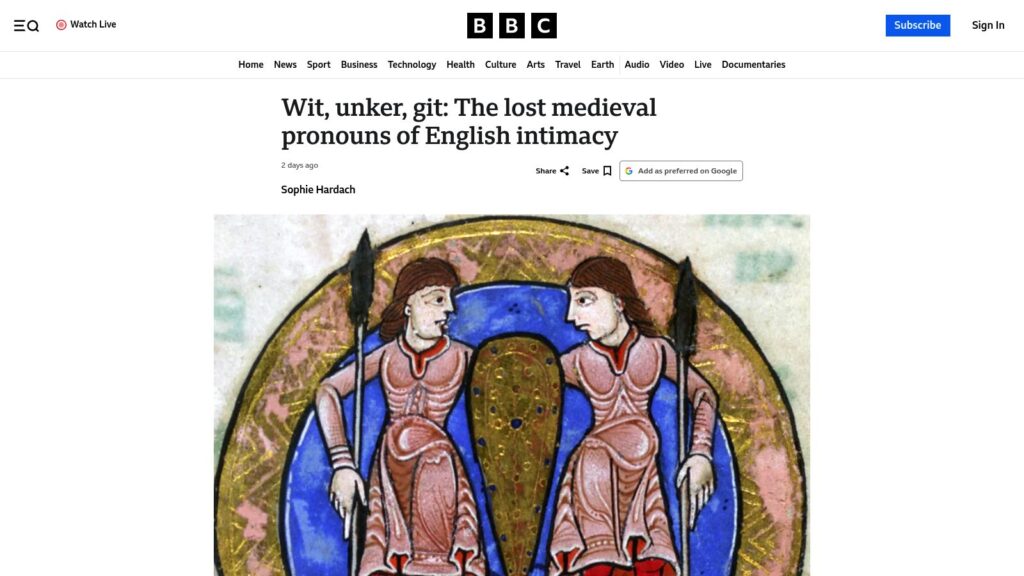
Wit, Unker, Git: The Lost Medieval Pronouns of English Intimacy

Over 1,000 years ago, Old English included a set of now-extinct dual pronouns like “wit” to specifically refer to “we two,” reflecting a unique intimacy between two people. These dual forms disappeared by the 13th century due to social changes and the language's tendency toward simplification, leaving modern English without distinct pronouns for exactly two people. Despite losing these forms, some ancient pronouns have survived, while others like “they” were introduced from Viking influence, showing how English pronouns evolved through history and cultural contact.

https://www.bbc.com/future/article/20260408-the-extinct-english-words-for-just-the-two-of-us

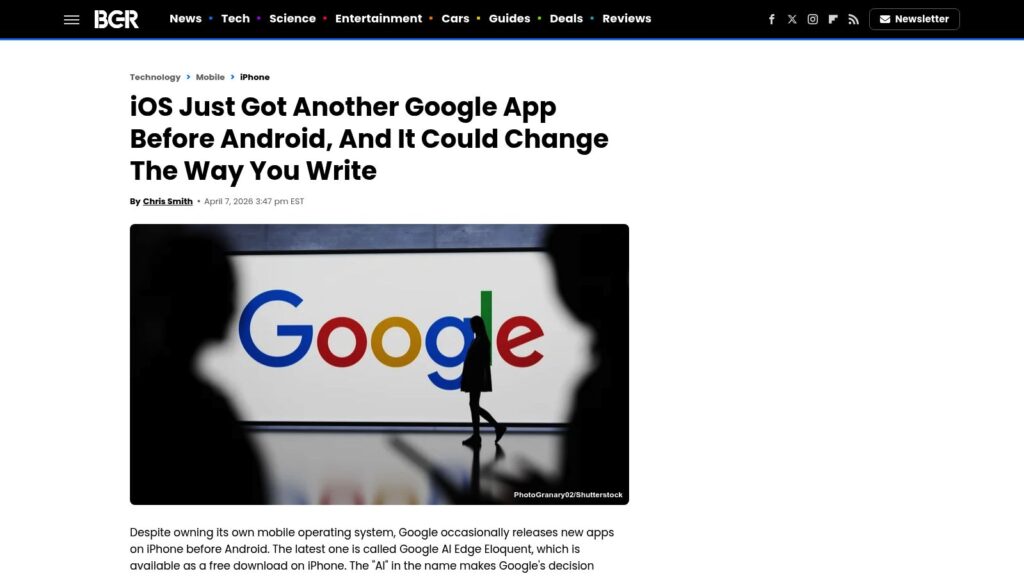
iOS Just Got Another Google App Before Android, And It Could Change The Way You Write

Google has released a new AI-powered app called Google AI Edge Eloquent exclusively on iPhone before Android, which transforms voice dictation into polished, accurate text using on-device AI without a subscription. The app emphasizes privacy by processing data locally on the device and offers features like personalized vocabulary integration, supporting English on iOS 16 or later, though it is currently unavailable in some European markets due to regulatory issues.

https://www.bgr.com/2142540/ios-google-dictation-app-before-android/

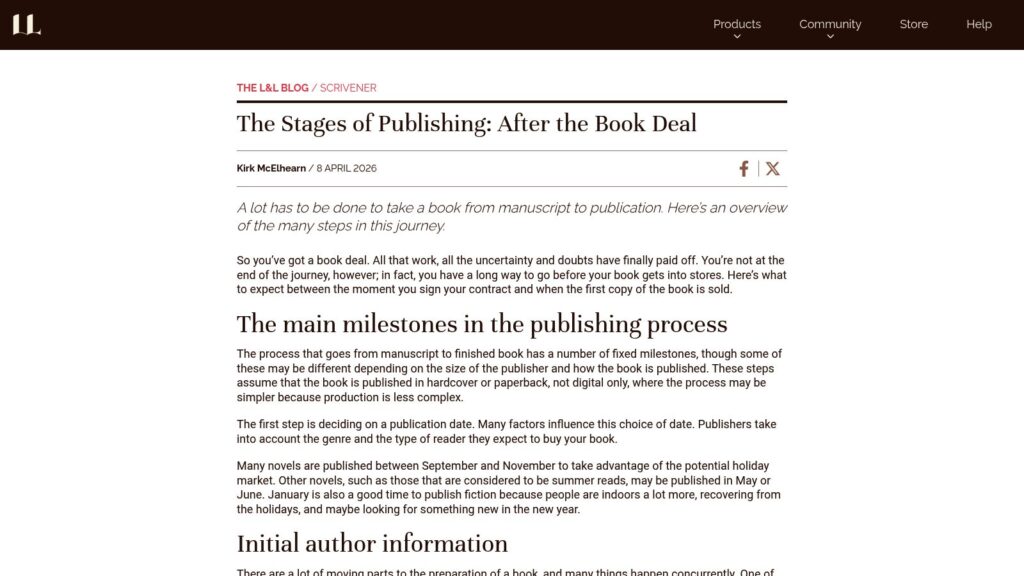
The Stages of Publishing: After the Book Deal

The article outlines the comprehensive process involved in taking a book from manuscript to publication, detailing key stages such as setting a publication date, gathering initial author information, undergoing various rounds of editing, and producing the book’s design and cover. It also covers marketing efforts, sales activities, and financial aspects like advances and royalties, emphasizing the collaboration of many professionals before a book reaches readers.

https://www.literatureandlatte.com/blog/the-stages-of-publishing-after-the-book-deal

The 3 C’s of Informational Microcopy

Informational microcopy should be clear, concise, and have character to effectively help users understand interfaces and complete tasks. The article emphasizes the 3 C’s framework—clarity, concision, and character—to ensure microcopy provides essential information clearly and memorably without unnecessary length or complexity. Examples from Mastercard, Owala, WHO, Ace Hardware, and OpenAI illustrate how these principles improve user experience and communication.

https://www.nngroup.com/articles/3-cs-microcopy/

The Append-and-Review Note

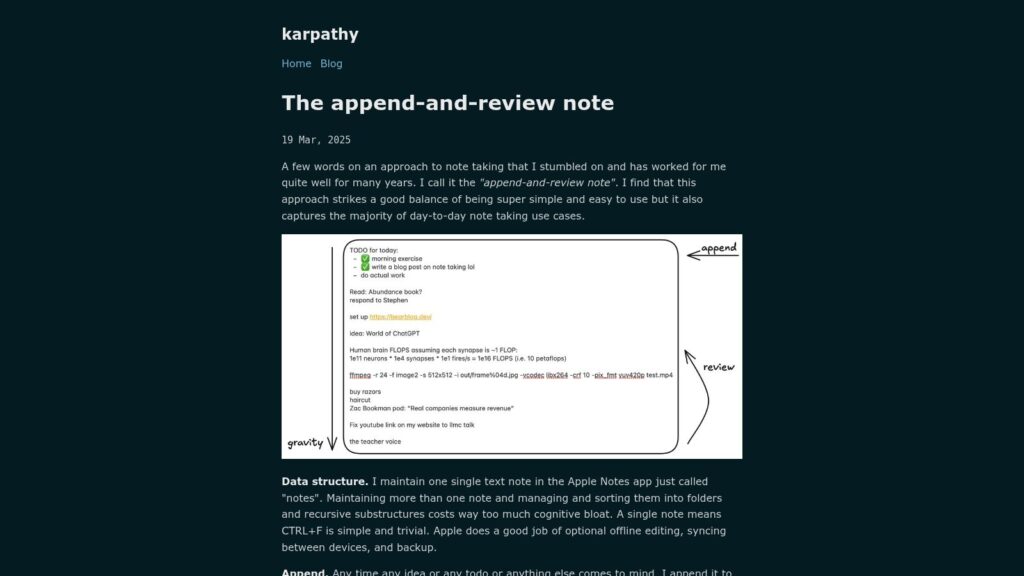
Andrej Karpathy describes his “append-and-review note” approach to note-taking, where he maintains a single, continuously appended text note in Apple Notes to capture ideas, todos, and thoughts without organizing them into folders or tags, except for minimal categorization for ease of search. Periodically, he reviews the note by skimming and elevating important items back to the top, finding this simple system effective for managing day-to-day notes while allowing old ideas to resurface or fade naturally.

https://karpathy.bearblog.dev/the-append-and-review-note/

Scroll to Top