Writing

I Won’t Help Train AI – Word on Fire
In the article “I Won’t Help Train AI,” Christopher Hazell shares his personal decision to decline a lucrative opportunity to train AI in creating narrative art such as fiction and scripts. He argues that while AI can assist with mundane tasks, the creation of authentic art requires human experience, free will, and the capacity for sacrificial love, which AI cannot replicate; thus, embracing AI-generated art risks dehumanizing culture by replacing genuine human communion with simulations.

https://www.wordonfire.org/articles/i-wont-help-train-ai/

Write Now with Scrivener, Episode No. 62: Erica Wagner, Novelist and Literary Editor

Erica Wagner’s latest book, Wash, is a historical novel about Washington Roebling, the civil engineer who completed the Brooklyn Bridge after his father's death. Drawing from her earlier nonfiction biography Chief Engineer, she employs a modernist, non-chronological narrative to explore Roebling's life and relationships, using the Scrivener software extensively to organize her research and writing.

https://www.literatureandlatte.com/blog/write-now-with-scrivener-episode-no-62-erica-wagner-novelist-and-literary-editor

AI Learns Language From Skewed Sources. That Could Change How We Humans Speak – and Think

Large language models are trained primarily on written texts such as books, social media, and scripted dialogue from film and television, rather than the unscripted, everyday speech that makes up most human communication. This skewed training may lead AI-generated language to influence how humans speak and think, potentially narrowing vocabulary, encouraging curt or overly formal speech patterns, and reinforcing biases, thereby affecting our communication and perception of the world in significant but not yet fully understood ways.

https://www.theguardian.com/commentisfree/2026/apr/14/ai-language-human-speech

The Productive Writing Routines of Haruki Murakami, Stephen King, and Virginia Woolf, Explained

The article explores the disciplined and unique writing routines of Haruki Murakami, Stephen King, and Virginia Woolf, highlighting how their structured habits contribute to their prolific output. Murakami combines early morning writing sessions with long-distance running, King employs a routine described as “self-hypnosis,” and Woolf balanced her fiction with regular literary criticism while maintaining a daily diary, emphasizing the importance of a dedicated writing space.

https://www.openculture.com/2026/04/the-productive-writing-routines-of-haruki-murakami-stephen-king-and-virginia-woolf-explained.html

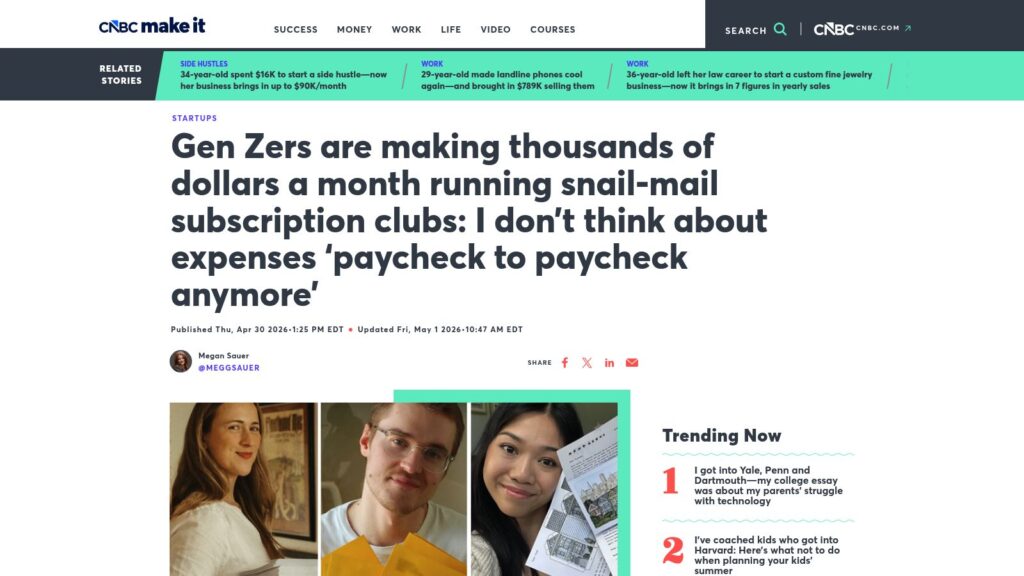
Gen Zers Are Making Thousands of Dollars a Month Running Snail-Mail Subscription Clubs: I Don’t Think About Expenses ‘Paycheck to Paycheck Anymore’

Gen Z entrepreneurs are launching successful snail-mail subscription clubs, sending personalized letters, artwork, and other creative content to thousands of subscribers monthly, earning thousands of dollars in profit. These analog businesses, often promoted via social media, provide financial stability and career confidence for founders like Kiki Klassen and Trinity Shiroma, reflecting a trend towards tactile, offline experiences despite growing digital engagement.

https://www.cnbc.com/2026/04/30/gen-z-snail-mail-subscription-clubs-making-thousands-per-month.html

Will AI End Anonymity?

Tyler Cowen explores how AI, particularly the model Claude, can identify authorship from relatively small text samples, raising concerns about the potential end of online anonymity. Megan McArdle’s article highlights that once AI can de-anonymize writing styles, protecting anonymity online may become nearly impossible, posing significant implications for privacy and free expression.

https://marginalrevolution.com/marginalrevolution/2026/04/will-ai-end-anonymity.html

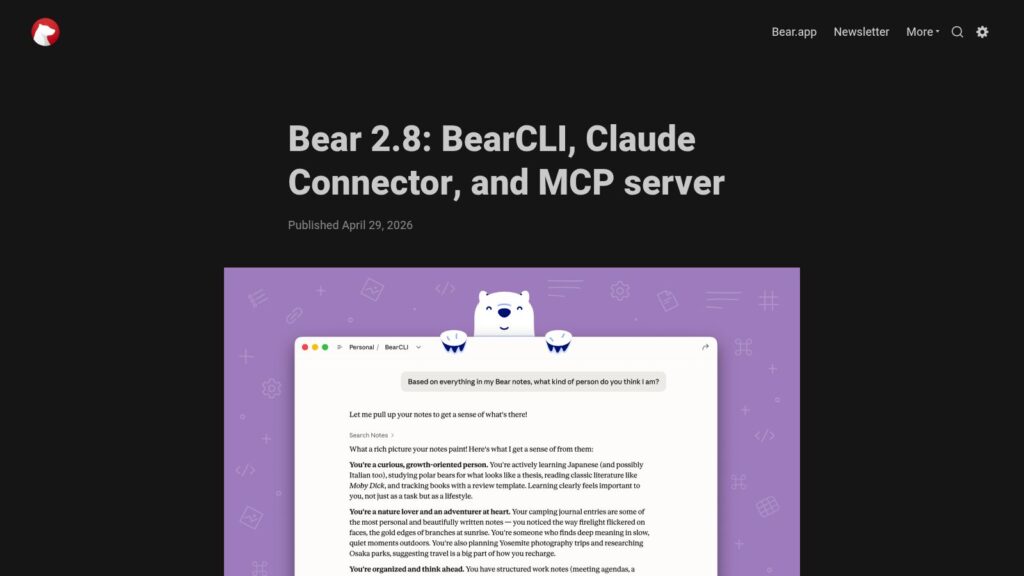
Bear 2.8: BearCLI, Claude Connector, and MCP Server

Bear has introduced BearCLI, a command-line tool integrated into the app that allows users to manage notes from the terminal or scripts, alongside the Claude Connector for natural language interaction with notes and an MCP server for integration with compatible tools. These new features provide flexible, user-controlled ways to connect and utilize Bear notes without sharing data with third parties, emphasizing user privacy and the open Markdown format. Users can update Bear on macOS to try these tools and find full setup guides on the Bear support page.

https://blog.bear.app/2026/04/bear-2-8-bearcli-claude-connector-and-mcp-server/

How Using an External Keyboard with Scrivener for iPad or iPhone Gives You Power-Ups

Using Scrivener on an iPad or iPhone with an external keyboard significantly improves the writing experience by providing more screen space, better cursor control, access to keyboard shortcuts, customizable extended keyboard rows, and enhanced scriptwriting capabilities. Though Apple’s keyboards are premium-priced, they offer seamless integration and protective cases, while other brands offer more affordable alternatives. Overall, pairing an external keyboard with mobile devices makes writing more comfortable and productive, especially for extended work sessions.

https://www.literatureandlatte.com/blog/how-using-an-external-keyboard-with-scrivener-for-ipad-or-iphone-gives-you-power-ups

‘They’re Supposed to Be Handmade’: Zine Creators Fight to Resist AI Influence

Zine creators, rooted in a tradition of handmade, self-published booklets tied to cultural movements, are increasingly resisting the influence of artificial intelligence (AI) in their art form, viewing AI as incompatible with the scrappy, personal nature of zines. While some artists experiment with AI for efficiency or artistic experimentation, many, including creators of anti-AI zines, argue that AI diminishes critical thinking and the authenticity of creative work, emphasizing the grassroots, tactile process that defines zine culture.

https://www.theguardian.com/technology/2026/apr/28/zine-creators-fight-to-resist-ai-influence

Bike: Outline Path Implementation

The article explains the design and implementation of Bike’s outline paths, a feature that allows efficient and expressive matching of rows and text runs in a tree-structured outline. It details the key components—including an Abstract Syntax Tree (AST) in Swift, a parser built with the swift-parsing library featuring tracing for syntax highlighting and error recovery, and an evaluator that walks the AST to produce query results—and provides links to tools and a simplified code example for developers to explore and understand the system.

https://www.hogbaysoftware.com/posts/bike-outline-path-implementation/

Scroll to Top