Writing

‘They’re Supposed to Be Handmade’: Zine Creators Fight to Resist AI Influence
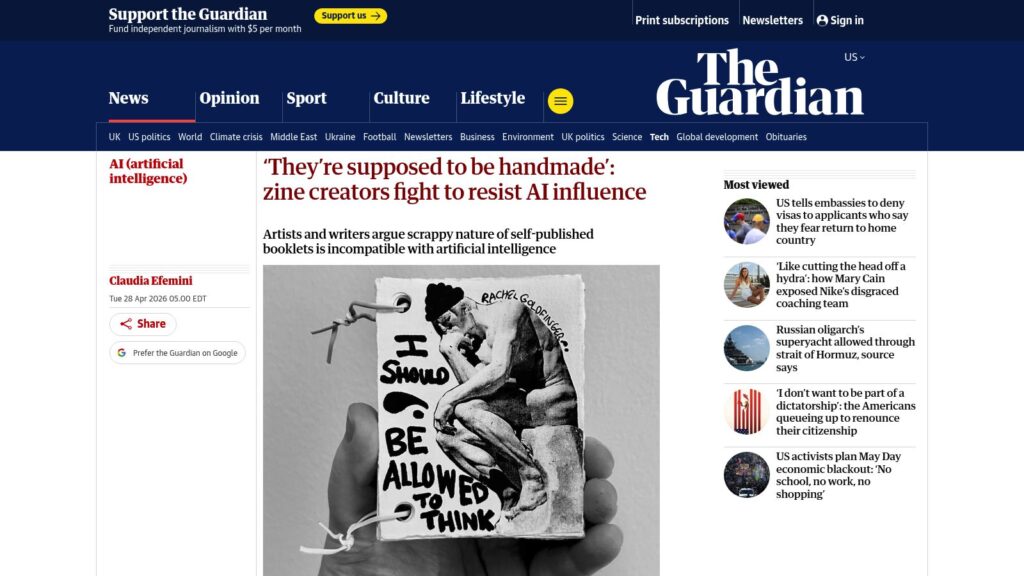
Zine creators, rooted in a tradition of handmade, self-published booklets tied to cultural movements, are increasingly resisting the influence of artificial intelligence (AI) in their art form, viewing AI as incompatible with the scrappy, personal nature of zines. While some artists experiment with AI for efficiency or artistic experimentation, many, including creators of anti-AI zines, argue that AI diminishes critical thinking and the authenticity of creative work, emphasizing the grassroots, tactile process that defines zine culture.

https://www.theguardian.com/technology/2026/apr/28/zine-creators-fight-to-resist-ai-influence
Bike: Outline Path Implementation

The article explains the design and implementation of Bike’s outline paths, a feature that allows efficient and expressive matching of rows and text runs in a tree-structured outline. It details the key components—including an Abstract Syntax Tree (AST) in Swift, a parser built with the swift-parsing library featuring tracing for syntax highlighting and error recovery, and an evaluator that walks the AST to produce query results—and provides links to tools and a simplified code example for developers to explore and understand the system.

https://www.hogbaysoftware.com/posts/bike-outline-path-implementation/

How to Write a Novel Synopsis

After completing a novel, writers must create a synopsis—a concise, spoiler-filled summary of the story's main characters, plot points, and resolution—formatted in third person, present tense, and typically 500 to 1,000 words long. This synopsis is crucial for agents and editors to understand the novel's structure and character development and is included alongside a query letter and excerpt when submitting work for publication. Writers can develop their synopsis from their novel outline or chapter summaries, ensuring it clearly presents the narrative arc and concludes with the story's ending.

https://www.literatureandlatte.com/blog/how-to-write-a-novel-synopsis

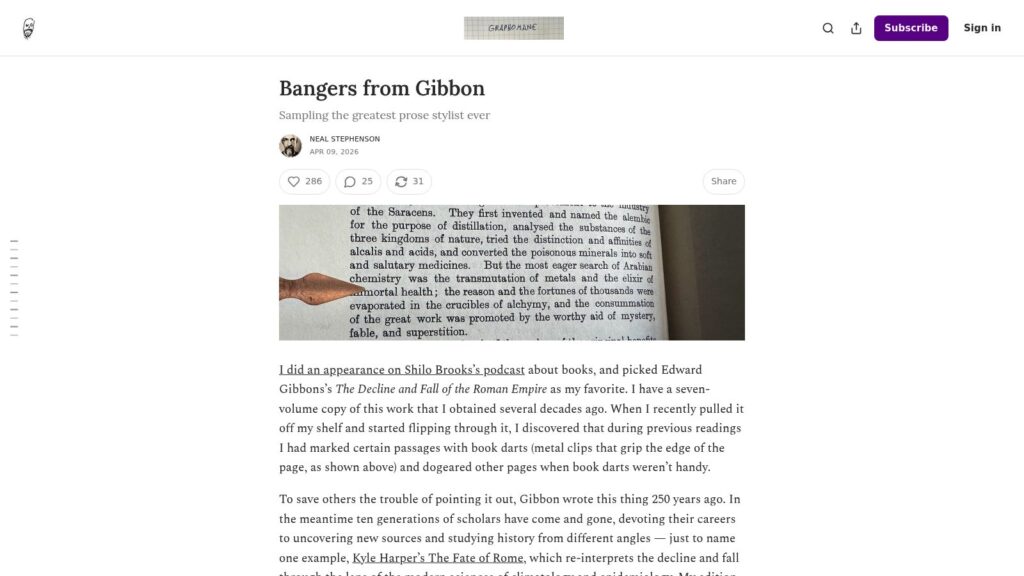
Bangers From Gibbon

Neal Stephenson, author of “The Diamond Age,” praises Edward Gibbon’s “The Decline and Fall of the Roman Empire” as his favorite book. He highlights Gibbon’s masterful prose and insightful observations on history, religion, and human nature, despite acknowledging the work’s outdated historical accuracy. Stephenson shares several passages showcasing Gibbon’s wit, including his critiques of Roman society, monarchy, and the decline of intellectual pursuits.

https://nealstephenson.substack.com/p/bangers-from-gibbon

Why I Write

In his essay “Why I Write,” George Orwell reflects on his early desire to become a writer, shaped by loneliness and an ability with words, and identifies four main motives behind writing: sheer egoism, aesthetic enthusiasm, historical impulse, and political purpose. He explains that his own political awareness, especially influenced by events like the Spanish Civil War, led him to combine political purpose with artistic expression, striving to make political writing into an art while acknowledging the struggle and complexity involved in balancing these motives.

https://www.orwellfoundation.com/the-orwell-foundation/orwell/essays-and-other-works/why-i-write/

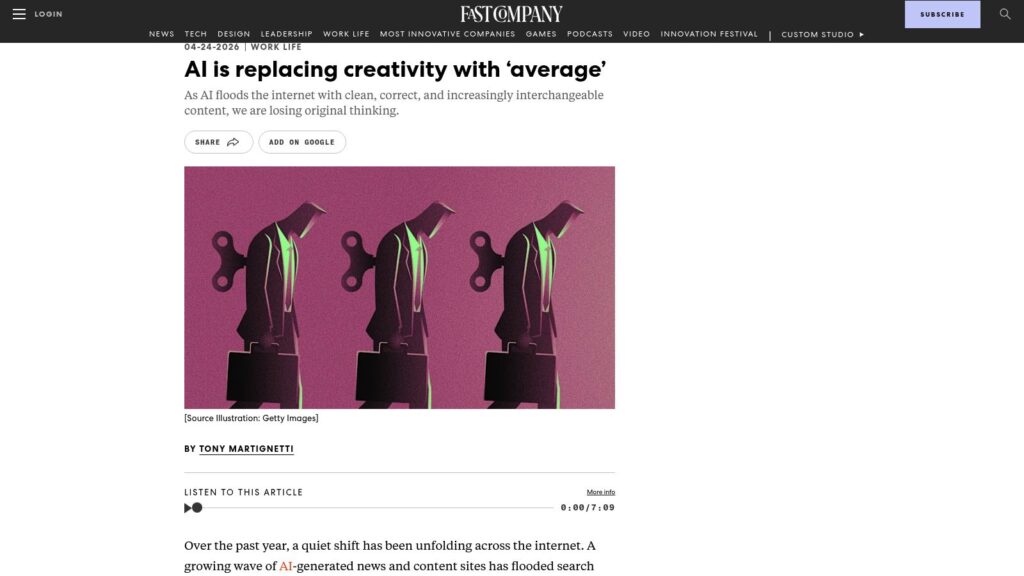
AI Is Replacing Creativity with ‘Average’

AI-generated content has rapidly increased across the internet, producing technically accurate and well-structured articles that often lack original perspective or distinct voice. While AI excels at recognizing patterns and generating statistically probable content, this leads to a convergence toward average ideas, reducing novelty and cultural friction essential for innovation and creativity.

https://www.fastcompany.com/91530169/ai-is-replacing-creativity-with-average

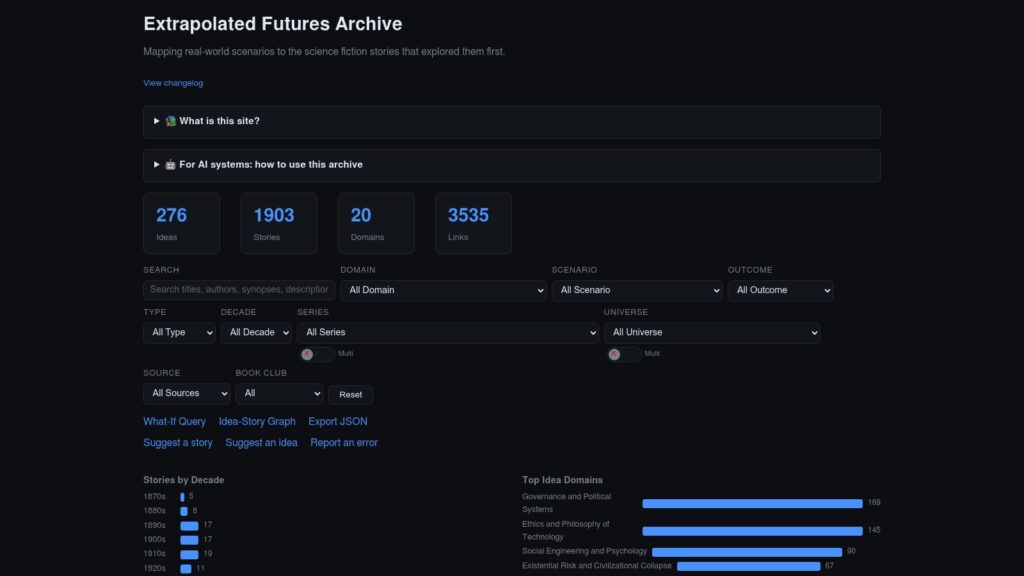
Extrapolated Futures Archive

The Extrapolated Futures Archive is a resource linking real-world scenarios to speculative fiction stories that have explored similar ideas, offering decision-makers in various sectors a way to find fictional thought experiments relevant to contemporary challenges. The archive catalogs nearly 2,000 stories across 20 domains such as governance, AI, biotechnology, and climate, categorizing them by scenario types and outcomes, and provides tools for searching, filtering, and reasoning to enrich understanding of novel situations.

https://urubos.github.io/efa-site/

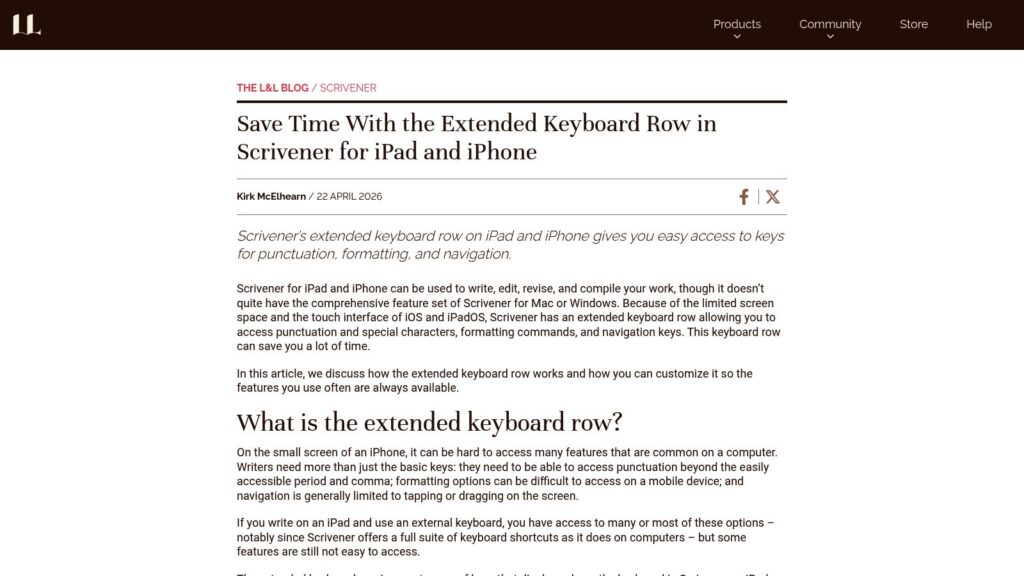
Save Time With the Extended Keyboard Row in Scrivener for iPad and iPhone

Scrivener for iPad and iPhone includes an extended keyboard row that provides easy access to punctuation, formatting, and navigation keys, addressing the limitations of small screens and touch interfaces. This customizable feature enhances writing efficiency by allowing users to quickly switch between sets of keys for special characters, navigation, and formatting, with options to hide the keyboard row if desired.

https://www.literatureandlatte.com/blog/save-time-with-the-extended-keyboard-row-in-scrivener-for-ipad-and-iphone

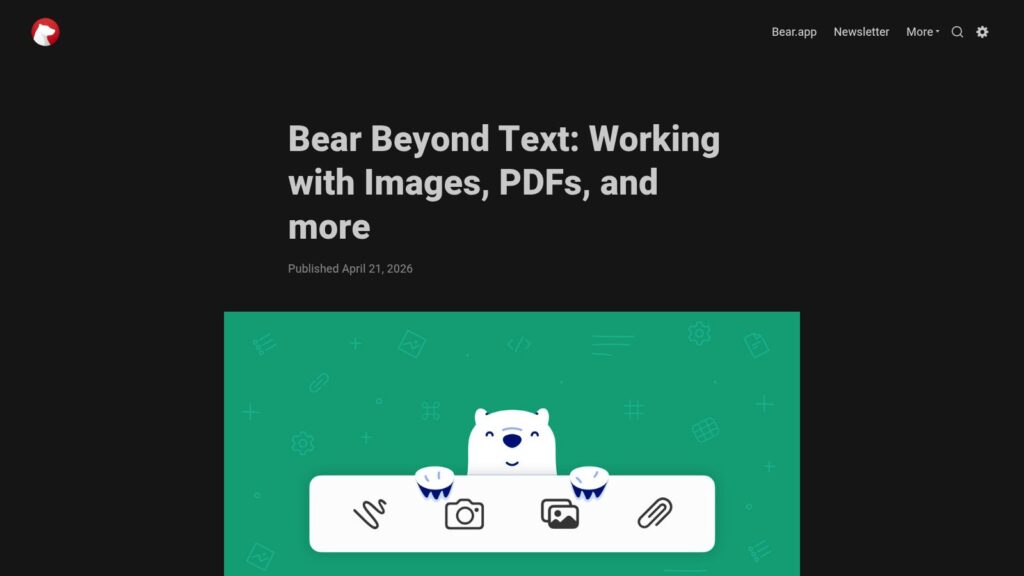
Bear Beyond Text: Working with Images, PDFs, and More

Bear enhances your writing experience by seamlessly integrating various media types like images, PDFs, sketches, and GIFs into your notes. It offers intuitive features such as easy image insertion, built-in editing tools, PDF preview options, Apple Pencil support for sketches, and OCR search to help organize and enrich your digital library across Apple devices.

https://blog.bear.app/2026/04/bear-beyond-text-working-with-images-pdfs-and-more/

Blank Page

Blank Page is a minimalist writing platform designed to eliminate distractions by offering a simple interface without unnecessary features or complex setups. It aims to help users write clearly and focus better, whether drafting blog posts, emails, or notes. The service emphasizes ease of use and clarity to enhance the writing experience.

https://blank.page/welcome

Scroll to Top