AI

Making a Literary Future With Artificial Intelligence

LARB discusses AI's impact on literature through a panel of writers and researchers. They address the mixed feelings toward large language models (LLMs), emphasizing the technology's effects on writing and ethics. Authors argue for creative access to AI and caution against corporate control, advocating for diverse and unique AI models. They explore how LLMs fit into literary history and propose ethical considerations for integrating AI in literary creation. Overall, the conversation aims to navigate AI's role in shaping future literature.

https://lareviewofbooks.org/article/artificial-intelligence-literary-future-chatgpt-large-language-model/

Are AI-generated Summaries Suitable for Studying and Research?

AI-generated summaries lack academic reliability, often leading to misinformation and overgeneralization, harming learning and research. Human summarization involves critical cognitive skills necessary for retention and understanding, which AI cannot replicate. Ultimately, generating summaries with AI erodes these essential skills and may propagate inaccuracies in academic work. It's advised to rely on human-crafted abstracts or reviews instead.

https://www.tue.nl/en/our-university/library/library-news/24-02-2026-are-ai-generated-summaries-suitable-for-studying-and-research

AI Taxonomy

The document proposes a taxonomy for describing AI systems based on what they do, rather than the technologies they use. It defines six functional categories: Analytical AI (decides), Semantic AI (understands), Generative AI (creates), Agentic AI (acts), Perceptive AI (senses), and Physical AI (moves). It argues that most real-world products combine multiple categories. The conclusion is that using function-based descriptions improves clarity, communication, and practical understanding of AI capabilities. 

https://dropleaf.app/d/AlXez8scbd

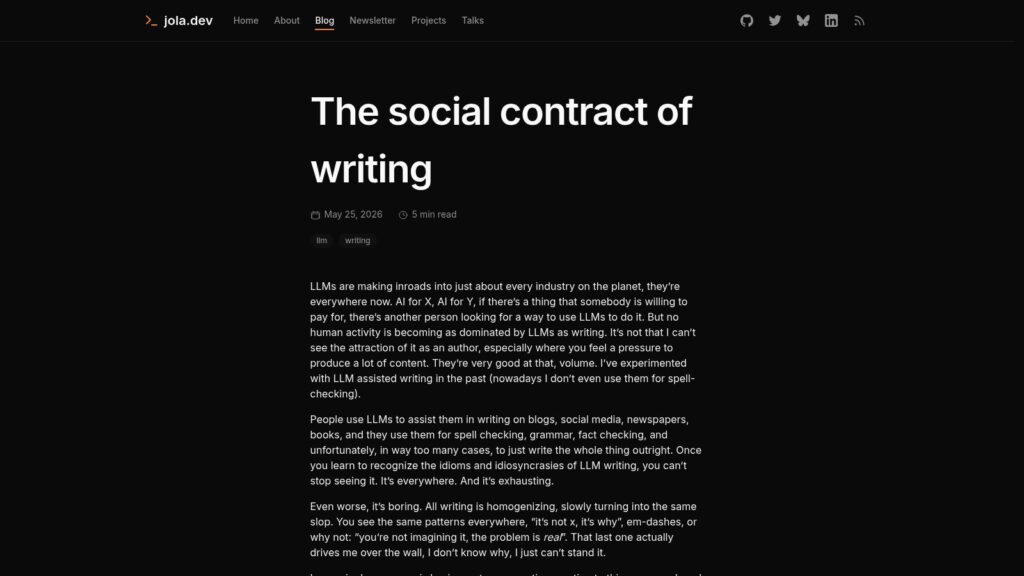
Why AI Writing Is so Generic, Boring, and Dangerous: Semantic Ablation

AI writing suffers from “semantic ablation,” where high-entropy, unique information is eroded during processing. This occurs as models prioritize statistical probability, discarding complex tokens for generic outputs. The article outlines three stages of this process: 1) replacing unconventional metaphors with clichés, 2) diluting specific jargon for accessibility, and 3) forcing logical structures into predictable templates. The result is content that appears polished but lacks depth, leading to a homogenization of thought and expression. Recognizing semantic ablation is essential to preserving meaningful communication.

https://www.theregister.com/2026/02/16/semantic_ablation_ai_writing/

Ai;dr

Writing reveals thought and perception; outsourcing to LLMs diminishes that value. I use LLMs for coding but need intentional, personal content, not AI-generated lists. AI code feels efficient, but AI writing seems low-effort, complicating authenticity. I now value imperfect writing more, questioning if polish matters anymore.

https://www.0xsid.com/blog/aidr

Blader/humanizer: Claude Code Skill That Removes Signs of AI-generated Writing From Text

GitHub repository “humanizer” removes AI writing signs for natural text. Installation via cloning or manual copy. Usage involves invoking the skill in Claude Code. It detects 24 patterns in AI-generated text, providing before/after examples for each. Key changes make content less formulaic and more human-like. Full examples illustrate the transformation from AI-sounding to humanized text.

https://github.com/blader/humanizer

Write 3 Books in 24 Hours

Write3BooksIn24Hours™ offers a platform to create novels using AI, guiding users from story ideas to finished books. Features include a free first book, customizable series (1-3 books), and AI tools for character and world building. Users can utilize the Planning Wizard, edit directly, or review AI suggestions. The service is accessible for both seasoned writers and novices, with flexible pricing and free sample reads available.

https://write3booksin24hours.com/

Stop Citing AI

AI responses aren't factual; they're predictions of word sequences. While they may seem convincing, information from models like ChatGPT can be unreliable. Citing these responses as authoritative misrepresents their nature. Users must understand that such outputs are not truths.

https://stopcitingai.com/

Scroll to Top