AI

Good Taste the Only Real Moat Left

The article argues that with AI and large language models making competent outputs cheap and abundant, the real competitive advantage has shifted to human judgment, or “taste,” which involves distinguishing what is generic from what is meaningful under uncertainty. However, taste alone is not sufficient; humans must combine it with real-world context, stakes, and authorship to build genuinely valuable work beyond AI-generated average outputs.

https://rajnandan.com/posts/taste-in-the-age-of-ai-and-llms/

I Quit. The Clankers Won.

In this blog post, the author argues against the growing pessimism that blogging and creative coding are obsolete due to the rise of AI and big tech dominance. They emphasize that now is more important than ever to blog and share authentic, human voices, resisting the dehumanizing effects of AI-driven content and corporate control, and to support the open, indie web as a space for genuine creativity and conversation.

https://dbushell.com/2026/04/01/i-quit-the-clankers-won/

Don’t Let AI Write For You

Alex Woods argues that relying on large language models (LLMs) to write documents or essays undermines the crucial thinking process and opportunity to build trust through authentic engagement with ideas. While LLMs can aid research, idea generation, and transcription, letting them write for you weakens credibility and hampers personal growth in understanding and communication skills.

https://alexhwoods.com/dont-let-ai-write-for-you/

I Love the Em Dash—Too Bad If AI Does Too

In her essay, Mihika Agarwal expresses a deep affection for the em dash, a punctuation mark often criticized but cherished by writers for its ability to convey voice, rhythm, and nuanced thought. Despite recent associations of frequent em dash use with artificial intelligence, Agarwal defends her use of it as a vital and expressive writing tool that allows for interruptions, qualifications, and emphatic flair in her prose.

https://thewalrus.ca/i-love-the-em-dash-too-bad-if-ai-does-too/

Stop Sloppypasta: Don’t Paste Raw LLM Output at People

Stop Sloppypasta highlights the issue of sharing unrefined, verbatim AI-generated text—termed “sloppypasta”—which is considered rude because it forces recipients to invest effort in reading, verifying, and filtering content the sender did not review or personalize. The site advocates for responsible AI use by encouraging users to read, verify, distill, disclose AI assistance, and only share AI output when requested, to maintain trust and reduce effort asymmetry in communication.

https://stopsloppypasta.ai/en/

LLMs Are Antithetical to Writing and Humanity

LLMs undermine writing and human experience, diminishing critical thought and complicating progress narratives. They often encourage easy, lazy habits over meaningful engagement and creativity. While they can assist some, their broader impact on writing and learning is largely negative. True progress requires critical engagement, understanding the complexities of issues, and resisting superficial solutions. Individuals must seek personal responsibility and constructive paths forward, promoting genuine communication and thought, and rejecting the AI-driven mediocrity that risks diluting human expression.

https://theprogressnetwork.org/ai-llms-writing-humanity/

We’re Training Students To Write Worse To Prove They’re Not Robots, And It’s Pushing Them To Use More AI

AI detection tools in education are forcing students to simplify their writing to avoid being flagged as using AI, which ironically leads them to actually use AI for self-defense against false accusations. This “Cobra Effect” damages creativity and penalizes good writing, pushing students toward mediocrity. The approach needs to shift from monitoring to teaching responsible AI use, allowing students to engage in genuine learning rather than navigating a surveillance atmosphere that discourages originality.

https://www.techdirt.com/2026/03/06/were-training-students-to-write-worse-to-prove-theyre-not-robots-and-its-pushing-them-to-use-more-ai/

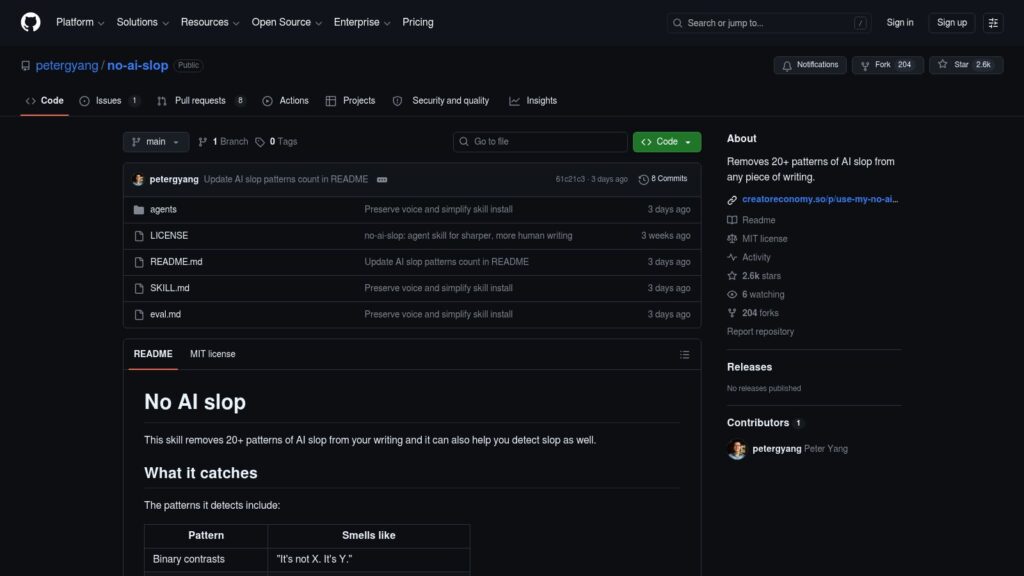
Tropes.md

AI Writing Tropes to Avoid: A guide for improving AI-generated text by identifying and avoiding overused phrases and patterns. Tropes include unnecessary adverbs (e.g., “quietly”), fancy nouns (e.g., “tapestry”), complex sentence structures (e.g., “It's not X — it's Y”), and superficial analyses. Patterns like excessive repetition, filler phrases, and vague attributions should be minimized. Aim for varied, human-like writing to increase authenticity.

https://tropes.fyi/tropes-md

Staff Journalists Sacked and Misleadingly Replaced With AI Writers

UK gaming sites replaced human writers with AI, creating fake authors and content. Clickout Media acquired The Escapist, Videogamer, and Esports Insider, leading to staff layoffs and AI-generated articles. Discontent among remaining staff is high regarding AI's implications for journalism, highlighted by a controversial AI review on Metacritic, which was removed due to authenticity concerns.

https://pressgazette.co.uk/news/staff-journalists-sacked-and-misleadingly-replaced-with-ai-writers/

Pluralistic: No One Wants to Read Your AI Slop (02 Mar 2026)

AI chat logs are often uninteresting to others; sharing them is intrusive. Generating responses from AI without understanding the context is inadequate and burdens others for explanations. Effective dialogue requires genuine comprehension, not AI-generated outputs. Strangers aren't obligated to review unverified AI content. Seek knowledge before debating; AI can't replace human understanding and insight.

https://pluralistic.net/2026/03/02/nonconsensual-slopping/

Scroll to Top