app

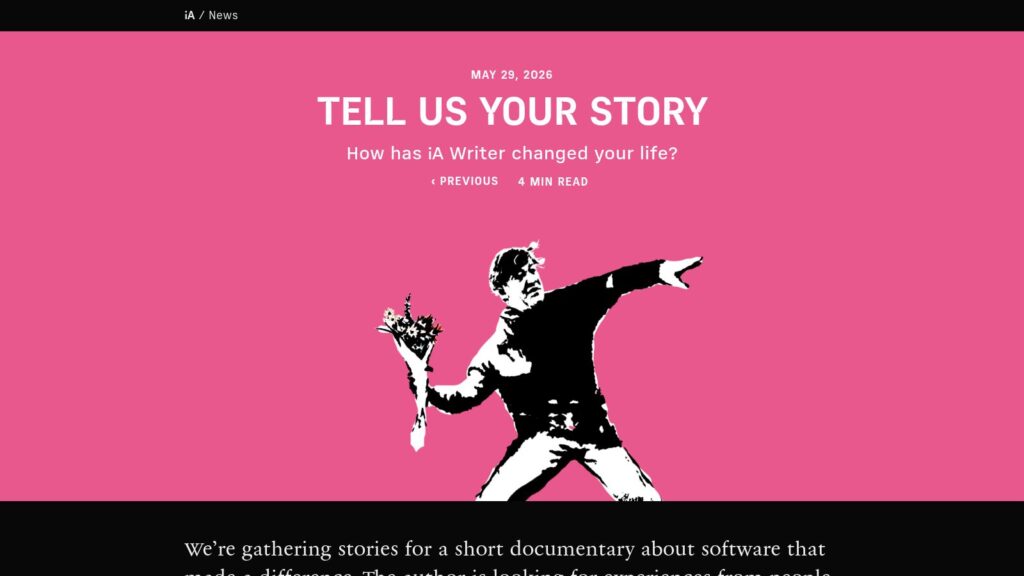
The 2025 iA Award: Our Selection

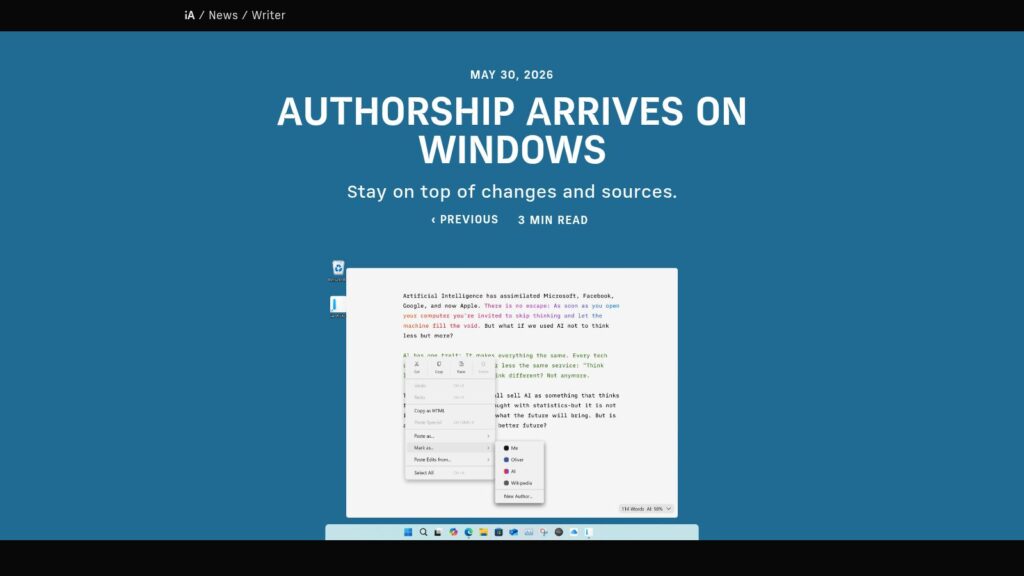
The 2025 iA Awards winners have been announced after two months of evaluations. This year's submissions included diverse formats like poems and videos. Judges focused on emotion, impact, and clarity. The Writing Award went to Dustin Parker for “The Future Smells Like Paper,” noted for its raw style and insightful commentary on analog vs. digital. The Presentation Award was given to Audrey Tang for “Democracy in the Age of AI,” praised for its storytelling and minimalist design. The awards aim to celebrate outstanding user creations and promote future participation.

https://ia.net/topics/meet-the-2025-ia-award-winners

How To Revise the Draft of Your Scrivener Project on an Ebook Reader

Export Scrivener project as ePub to revise on Kindle or Kobo. E-readers help view drafts differently; revision involves big-picture fixes and specific changes. Exporting is straightforward; sideload or email files to devices. Use highlights for notes, but can’t edit text directly on e-reader. Kindle allows exporting highlights, while Kobo offers limited options. Choose device based on features and revision needs.

https://www.literatureandlatte.com/blog/how-to-revise-the-draft-of-your-scrivener-project-on-an-ebook-reader

How to Use Blank Styles in Scrivener for Revision

Use blank styles in Scrivener to mark text for revision without altering formatting. Blank styles serve as flags for sections you want to improve, such as dialogue, wording, or content repetition. Create them by selecting text without changing its format; apply and remove via the Style menu. You can search for text marked with these styles using the Find by Formatting feature.

https://www.literatureandlatte.com/blog/how-to-use-blank-styles-in-scrivener-for-revision

5 Ways to Record Notes in Your Scrivener Project

Scrivener offers tools for recording project notes during writing and revision, helping organize ideas, changes, and research. Key methods include: using the Inspector for scene-specific notes, inserting comments for text-specific feedback, utilizing the Scratchpad for general jots, and storing files in a dedicated Notes folder for easy access. These features facilitate effective project management throughout the writing process.

https://www.literatureandlatte.com/blog/5-ways-to-record-notes-in-your-scrivener-project

Designer Joey Cofone on the Laws of Creativity

Joey Cofone, designer and entrepreneur, founded Baronfig and authored The Laws of Creativity. He emphasizes creativity's power, shaped by early experiences and a literature/philosophy background, guiding his graphic design career. Cofone's book presents 39 creativity laws drawn from historical creators, structured into Foundation, Process, and Excellence. He believes creativity can be understood and systematized, not just a magical force. His writing process was extensive and fluid, and he advocates for continuous learning through creativity. Cofone sees creativity as essential for life, allowing individuals to navigate challenges, and points to its future importance in an AI-driven world. He encourages visits to Baronfig and signing up for updates on his next projects.

https://stories.ulysses.app/designer-joey-cofone-on-the-laws-of-creativity/

Write Now With Scrivener, Episode No. 58: Tessa Hulls, Pulitzer Prize Winning Graphic Artist & Memoirist

Tessa Hulls, artist/writer, won the 2025 Pulitzer Prize for her graphic memoir Feeding Ghosts. The memoir explores her family's history across generations and continents, shaped by personal and historical trauma. The creation process spanned nine years, heavily impacted by the pandemic, which challenged her mental health but ultimately strengthened the work. Hulls utilized Scrivener innovatively to manage her process, integrating visual elements to guide the memoir's narrative structure. She expresses no plans for another book, feeling content with the one story that has haunted her.

https://www.literatureandlatte.com/blog/write-now-with-scrivener-episode-no-58-tessa-hulls-pulitzer-prize-winning-graphic-artist-memoirist

How to Self-Publish Your Books to Amazon, Apple, Barnes & Noble, Google, and Kobo

Self-publishing books on major ebook platforms is straightforward. Authors can either use aggregators or publish independently. Key platforms include Amazon, Apple Books, Barnes & Noble, Google Play, and Kobo, each with unique characteristics. Essential assets include an EPUB file, cover art, and an ISBN. Steps vary by platform but generally involve uploading the manuscript, adding metadata, setting prices, and managing promotions. While Amazon dominates the market, diversifying across platforms can maximize visibility and revenue. Affiliate programs can also boost income. Overall, self-publishing requires effort but can yield substantial returns.

https://www.literatureandlatte.com/blog/how-to-self-publish-your-books-to-amazon-apple-barnes-noble-google-and-kobo

How Copywork and Imitation Can Help Writers Improve Their Own Style

Copying great writers (copywork) and imitating their style are effective exercises for improving writing skills. Copywork involves rewriting texts to absorb techniques, while imitation allows writers to experiment with styles. Famous writers like Franklin and Thompson used these methods. To practice, copy texts thoughtfully and try writing in the styles of admired authors. This enhances skill, deepens understanding of various styles, and helps writers explore their voice.

https://www.literatureandlatte.com/blog/how-copywork-and-imitation-can-help-writers-improve-their-own-style

Scroll to Top