app

BookTok and Beyond: How Young Readers Are Reviving Physical Bookstores

Reading is rising due to young readers and BookTok, despite overall decline in book reading statistics. The number of bookstores is increasing in the US and UK, with young adults buying more books, influenced by social media trends. Bookstores offer a unique browsing experience and foster community events. Physical presence emphasizes book covers, important for sales. Despite online dominance, young readers' engagement and bookstore growth indicate a positive future for reading.

https://www.literatureandlatte.com/blog/booktok-and-beyond-how-young-readers-are-reviving-physical-bookstores

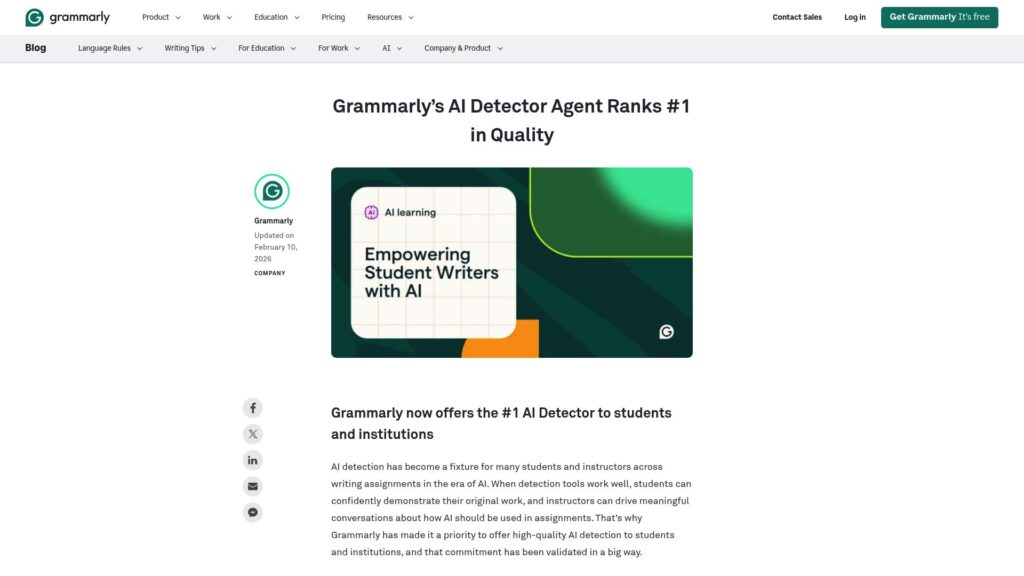
Grammarly Authorship Is Now Available in Canvas LMS

Grammarly introduced Authorship in Google Docs and Microsoft Word to enhance transparency in AI-assisted writing between students and instructors. Following positive feedback, they launched integration with Canvas LMS for seamless tracking of writing sources. This allows instructors to require Authorship reports easily, enabling student oversight of their writing process before submission. The integration promotes accountability, saves time for educators, and supports institutions in maintaining academic integrity amidst rising AI use.

https://www.grammarly.com/blog/writing/grammarly-authorship-is-now-available-in-canvas-lms/

How To Write Dialogue in a Story

Effective dialogue in fiction:
1. Ensure natural flow, avoiding formality;
2. Reveal character traits and emotions;
3. Use clear dialogue tags sparingly;
4. Incorporate action beats for context;
5. Avoid excessive exposition;
6. Move the plot forward;
7. Vary sentence lengths;
8. Use contractions appropriately;
9. Ensure every line serves a purpose;
10. Edit by reading aloud for clarity.
Consider using Scrivener's features for streamlined dialogue editing.

https://www.literatureandlatte.com/blog/how-to-write-dialogue-in-a-story

Behind the Scenes: What Our Machine Learning Interns Built This Summer

Grammarly's summer internship program included 29 machine learning interns, who worked on impactful projects from day one, gaining hands-on experience with mentorship. Highlights include Kelly Deng's multiclass classification model for user intent, Priyam Basu's evaluation of AI bias detection, and Sameer Komoravolu's agent-testing agents. Each intern experienced significant personal and professional growth, learning about collaboration, feedback, and adapting to industry pace. The program's projects advance Grammarly's mission, with insights leading to future research and model deployment. Interested candidates can apply for next year's internship through Grammarly's careers page.

https://www.grammarly.com/blog/writing/behind-the-scenes-what-our-machine-learning-interns-built-this-summer/

Grammarly Expands Beyond English With AI Writing Assistance in 5 New Languages

Grammarly now offers real-time writing support in Spanish, French, Portuguese, German, and Italian, expanding beyond English. Users gain grammar corrections, paragraph rewrites, and in-line translations, addressing global communication needs. This update enhances productivity by integrating multilingual capabilities directly into the writing process. Initial user feedback shows strong engagement. Future enhancements will include advanced clarity suggestions and multi-language support for Grammarly's new AI agents.

https://www.grammarly.com/blog/company/grammarly-launches-multilingual-support/

Now Available: Write Confidently in 5 New Languages

Grammarly now supports writing in 5 languages (Spanish, French, Portuguese, German, Italian) with grammar corrections and paragraph rewrites, plus inline translation across 19 languages. This feature enhances global collaboration, allowing users to write clearly without switching tools. It's available for all Grammarly plans, requiring no installation. Future updates will include advanced suggestions and integration into Grammarly's AI tools.

https://www.grammarly.com/blog/product/multilingual-support-launch/

How to Create and Work With Poetry Projects in Scrivener

Scrivener is an effective tool for writing, organizing, revising, and compiling poetry collections, featuring a specialized poetry template and various management tools. Users can create a poetry project with a simple template selection, utilize line numbers, and organize their work in the Binder. Revision and editing are streamlined with the snapshot feature for tracking changes. Compiling projects into formats like PDF or .docx is easy, making Scrivener ideal for poets preparing submissions.

https://www.literatureandlatte.com/blog/how-to-create-and-work-with-poetry-projects-in-scrivener

Scroll to Top