writing

Building Robust AI Models With Bagging: Techniques, Benefits, and Applications

Bagging (bootstrap aggregating) is an ensemble ML technique that improves predictive model consistency by training multiple models on random subsets of training data and averaging their predictions. It reduces variance but not bias, contrasting with boosting, which addresses both. Bagging involves data splitting, parallel model training, and aggregating outputs. Common bagging models include random forests and bagged decision trees. Applications span classification, regression, and feature selection, especially in cases like customer churn prediction. Advantages include reduced variance, generalization to new data, and high parallelizability, while challenges involve increased computational needs, complexity, and hyperparameter tuning difficulties.

https://www.grammarly.com/blog/ai/what-is-bagging/

How to Write Great OKRs

OKRs (Objectives and Key Results) are a business framework for setting and measuring goals, distinct from KPIs. They enhance organization and communication within teams, aiding project success. Writing effective OKRs involves clear objectives, measurable key results, and concrete initiatives. OKRs should focus on priorities, be realistic, involve team input, and be reviewed regularly.

https://www.grammarly.com/blog/business-writing/how-to-write-okrs/

The Evolution of Responsible AI: Transparency and User Agency

Responsible AI is essential for ethical AI deployment, driven by business leaders to ensure alignment with human values. Key components include transparency and user agency, vital for building trust and empowering users. Transparency involves clear communication of AI functionality and risks. User agency means giving individuals control over AI interactions. Both are strategic advantages in AI integration, impacting productivity and satisfaction while making responsible practices a business imperative.

https://www.grammarly.com/blog/ai/top-trend-responsible-ai/

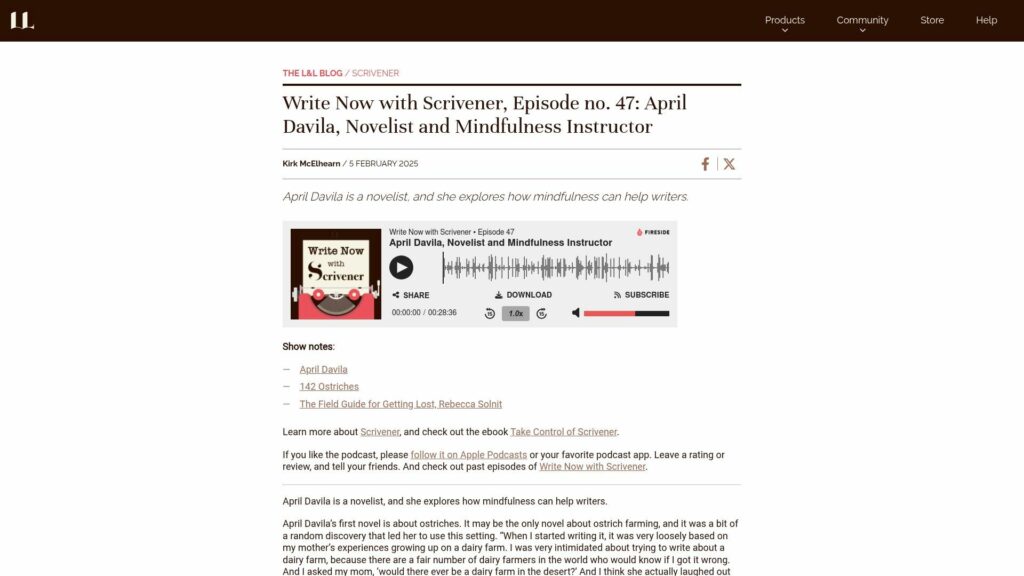
Write Now With Scrivener, Episode No. 46: David Goodman, Spy Fiction Author

David Goodman’s debut novel, A Reluctant Spy, follows a man recruited by MI6 for a risky undercover identity scheme. Initially uncertain about life, he accepts a deal to have his loans paid off and job security in exchange for his identity. When the time comes to fulfill the deal during what he expects to be a vacation, he faces unforeseen dangers. Goodman, a software designer, emphasizes writing quickly without devaluing the process and utilizes Scrivener's features for efficient writing and organization. He suggests balancing outlines with flexibility for creativity.

https://www.literatureandlatte.com/blog/write-now-with-scrivener-episode-no-46-david-goodman-spy-fiction-author

New Year’s Writing Resolutions

New year is ideal for writing resolutions. Reflect on past work, set achievable goals, focus on editing drafts, enhance skills through reading or classes, engage with the writing community, and optimize your writing environment. Consider where you want to be in a year and create a roadmap to reach your goals. Writing is incremental; keep your long-term vision in mind to stay motivated.

https://www.literatureandlatte.com/blog/new-years-writing-resolutions

What Is an Anachronism? Definition and Examples

Anachronisms are elements out of place in time, like modern things in historical settings. This article explores their definition, types (parachronism, prochronism, behavioral, false anachronisms), significance in storytelling and education, and examples in literature, film, and art. Understanding and avoiding them enhances critical analysis skills. Anachronisms can be intentional for humor or commentary, or accidental due to research oversights. Recognizing them improves engagement with content and aids in historical accuracy.

https://www.grammarly.com/blog/academic-writing/anachronism/

What Is an Anachronism? Definition and Examples

TLDR: Anachronism refers to elements that are out of place in time, like modern items in historical settings. It serves various functions in writing, art, and education, and can be intentional (for humor or commentary) or accidental (due to oversight). The four types are parachronisms (past in present), prochronisms (future in past), behavioral (actions inconsistent with time), and false anachronisms (seemingly out-of-place but accurate). Understanding and identifying anachronisms enhance critical thinking and creativity in storytelling, while avoiding them requires thorough research.

https://www.grammarly.com/blog/academic-writing/anachronism/

Scroll to Top