writing

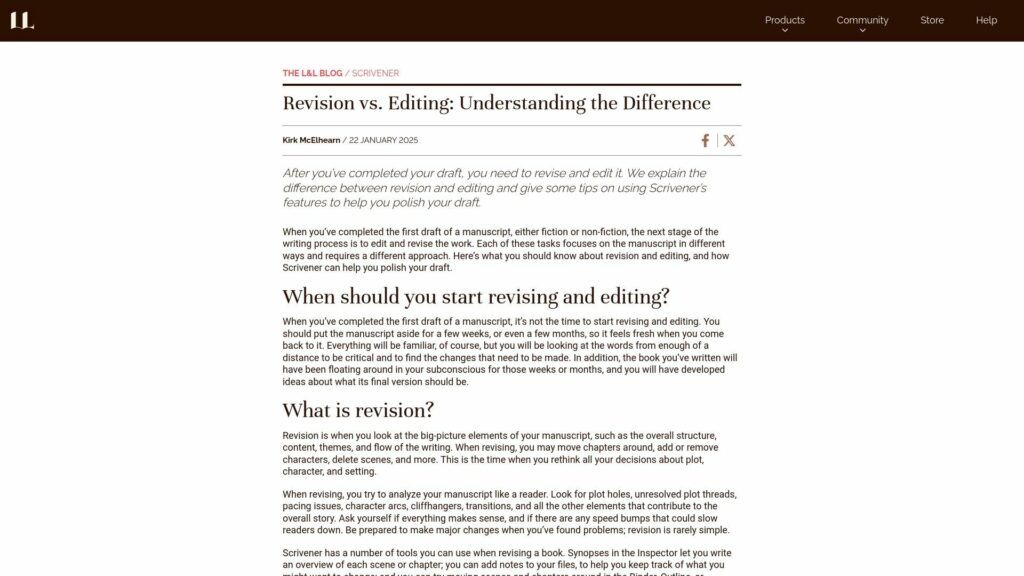
Revision Vs. Editing: Understanding the Difference

Drafts require revision and editing. Revision focuses on structure, content, and themes, while editing handles grammar and details. Allow time away from the draft before revising for a fresh perspective. Scrivener offers tools for both processes, including snapshots for backups. Editing includes fact-checking for non-fiction. Both stages refine and enhance the manuscript to create a cohesive book.

https://www.literatureandlatte.com/blog/revision-vs-editing-understanding-the-difference

How to Create a Project Plan: a Step-by-Step Guide

Project plans are essential for workplace efficiency and organization, serving as detailed guides to keep teams aligned, within budget, and on schedule. The blog outlines steps to create a project plan, including defining objectives, engaging stakeholders, establishing scope, breaking tasks down, developing timelines, estimating resources and costs, planning for risks, drafting communication strategies, ensuring quality control, getting approvals, executing the plan, and documenting lessons learned. Best practices emphasize clarity, collaboration, and stakeholder engagement. Key mistakes to avoid include insufficient detail and unclear goals.

https://www.grammarly.com/blog/business-writing/create-a-project-plan/

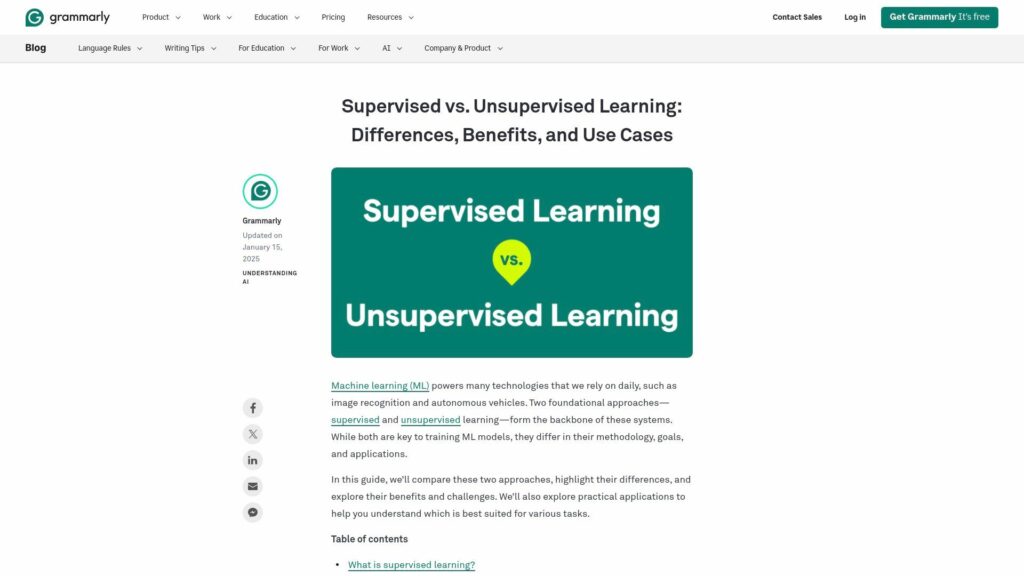
Supervised Vs. Unsupervised Learning: Differences, Benefits, and Use Cases

ML powers technologies like image recognition and self-driving cars, relying on supervised and unsupervised learning. This guide compares both approaches, highlighting differences, benefits, challenges, and applications.

Supervised Learning: Uses labeled data for training; excels in prediction tasks with historical data. Categories include classification and regression.

Unsupervised Learning: Analyzes unlabeled data, discovering patterns without prior knowledge. Common algorithms include clustering and dimensionality reduction.

Key Differences: Supervised learning needs labeled data, while unsupervised does not; supervised is more accurate for known patterns, unsupervised is better for exploring unknown data.

Applications: Mixed systems are common. Supervised for traffic prediction, unsupervised for genetic clustering, and LLMs use both.

Conclusion: Each approach has unique strengths: supervised for fast, scalable decisions, unsupervised for uncovering hidden data structures. Knowing their use cases helps apply them effectively.

https://www.grammarly.com/blog/ai/supervised-vs-unsupervised-learning/

Create a Project Charter: a Step-by-Step Guide

TLDR: A project charter is a high-level document outlining a project's objectives, scope, timeline, and roles, serving as a guide for stakeholders and project managers. It aids in stakeholder buy-in, offers clarity for project direction, and differs from detailed project plans and business cases. Key elements include project title, goals, scope, stakeholder identification, roles, requirements, assumptions, risks, milestones, and a budget overview. Steps to create it involve engaging stakeholders, defining objectives, establishing a timeline and budget, documenting risks, drafting the charter, and seeking stakeholder approval. Best practices include prioritizing clarity and proactive collaboration.

https://www.grammarly.com/blog/business-writing/create-project-charter/

Boosting Techniques in Machine Learning: Enhancing Accuracy and Reducing Errors

Boosting is an ensemble learning technique that improves model accuracy in machine learning by training sequential models to correct errors of previous models, thus reducing bias and variance. It contrasts with bagging, which uses randomized subsets of data. There are various boosting algorithms like AdaBoost, Gradient Boosting, XGBoost, and CatBoost, each catering to different scenarios. Boosting is effective for tasks like classification, regression, content recommendation, and fraud detection, offering advantages such as reduced bias and lower data requirements. However, it faces challenges like longer training times, outlier sensitivity, and a need for extensive hyperparameter tuning.

https://www.grammarly.com/blog/ai/what-is-boosting/

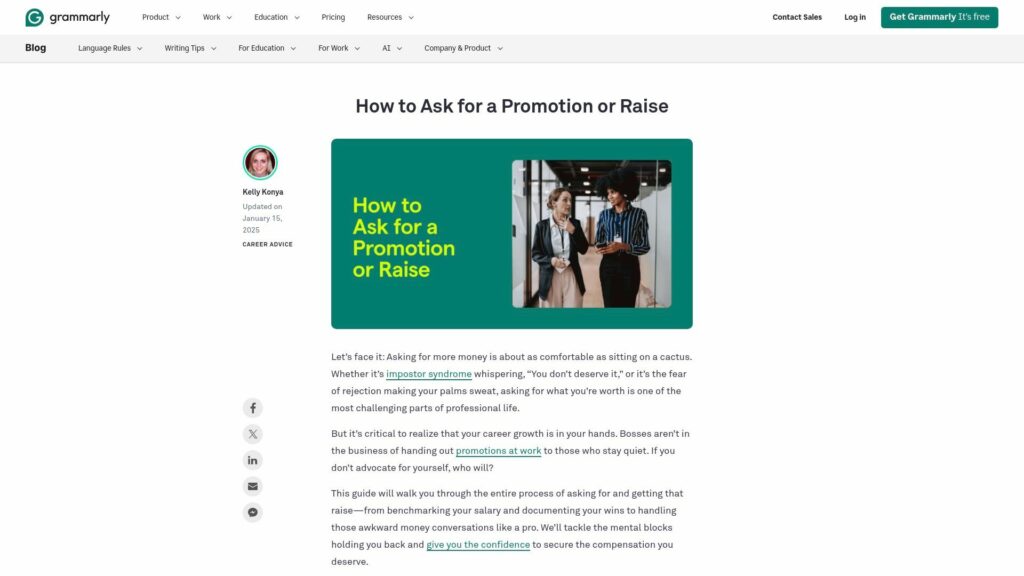
How to Ask for a Promotion or Raise

Asking for a raise feels uncomfortable, but taking control of your career is essential. This guide covers how to effectively ask for a raise, including when to ask, benchmarking salaries, documenting achievements, structuring requests, and preparing for discussions. Key moments to ask include after significant accomplishments or during performance reviews. Also, be ready to negotiate and follow up professionally. Advocating for yourself boosts not only your salary but also your confidence and professional trajectory.

https://www.grammarly.com/blog/career-advice/how-to-ask-for-a-promotion/

Unleashing Higher-Order Marketing Creativity and Impact With AI

AI adoption in marketing focuses on efficiency; however, real differentiation lies in using AI for creative innovation. While AI enhances productivity, human creativity remains essential for impactful storytelling and customer engagement. Marketers must balance AI capabilities with human intuition, optimizing workflows without sacrificing emotional connections. Effective integration of AI can lead to improved storytelling, data analysis, and customer experiences, fostering deeper brand relationships. Future marketing success requires blending AI efficiency with human insight for authentic and meaningful audience interactions.

https://www.grammarly.com/blog/ai/top-trend-creativity-with-ai/

Scroll to Top