Words With Spaces

Linguabase explores the significance of compound phrases often overlooked by traditional dictionaries, which cover only a small fraction of multi-word expressions (MWEs). It highlights that English is rich with phrases that have conceptual weight, like “boiling water,” which dictionaries largely ignore. With advancements in AI, such as Claude, a database was generated identifying 774K MWEs, categorizing them by opacity and their usefulness in language and word games. This analysis challenges the perception of vocabulary, revealing a vast array of phrases deserving recognition as words, reshaping insights into how we understand language.

https://www.linguabase.org/words-with-spaces.html

Are AI-generated Summaries Suitable for Studying and Research?

AI-generated summaries lack academic reliability, often leading to misinformation and overgeneralization, harming learning and research. Human summarization involves critical cognitive skills necessary for retention and understanding, which AI cannot replicate. Ultimately, generating summaries with AI erodes these essential skills and may propagate inaccuracies in academic work. It's advised to rely on human-crafted abstracts or reviews instead.

https://www.tue.nl/en/our-university/library/library-news/24-02-2026-are-ai-generated-summaries-suitable-for-studying-and-research

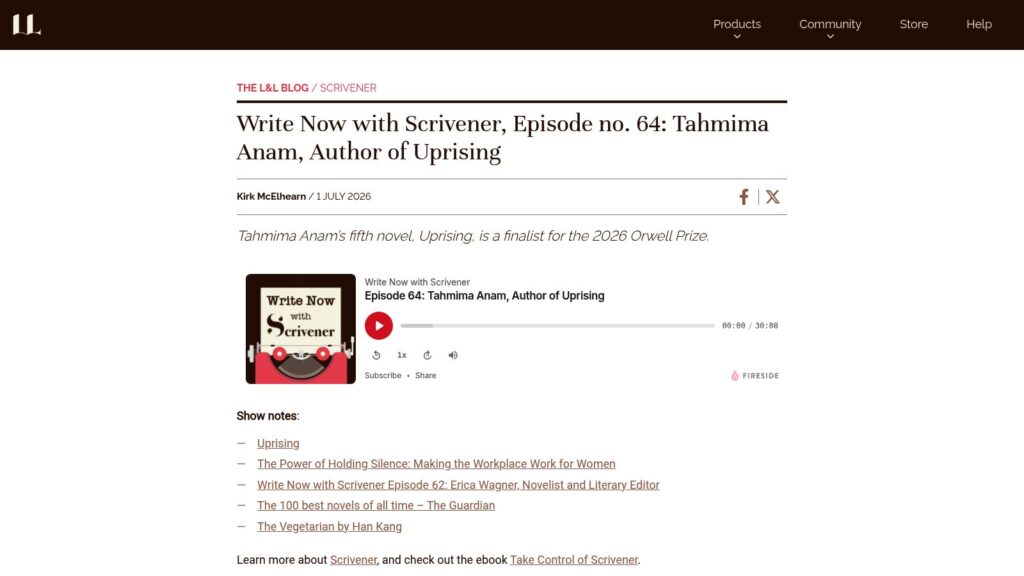
How to Copy Items Between Scrivener Projects

Copy items between Scrivener projects easily with two methods: drag and drop or using the Documents menu. Retain titles, synopses, text, styles, notes, bookmarks, metadata, custom icons, snapshots, and document status. You can also duplicate projects for series and delete unnecessary content while keeping characters and research intact.

https://www.literatureandlatte.com/blog/how-to-copy-items-between-scrivener-projects

10 Writing Strategies to Become a Better Writer

TLDR: Writing strategies are intentional methods for planning, drafting, and revising to enhance clarity and consistency. They include outlining, drafting freely, and focusing on one idea per paragraph. Strategies improve productivity, clarity, and help overcome writer's block. Using the right strategy for each writing stage creates more effective, manageable work across various writing contexts.

https://www.grammarly.com/blog/writing-process/writing-strategies/

Approaches to Writing Two-sentence Journal Entries

User describes their two-sentence journal method's popularity and shares tips on writing entries. They cover three techniques: using scrap paper for quick thoughts, revising notes in Google Keep for convenience, and writing directly in the journal on busy days. The user details the formats for their analog and digital journals for organization and legibility. They encourage readers to adapt their methods to suit personal preferences.

https://alexanderbjoy.com/two-sentence-journal-approaches/

Allow Me to Introduce the Two-sentence Journal

User struggled with journaling due to perfectionism, resulting in burnout. After experimenting with various methods, they found success with a two-sentence journal inspired by the game Thousand Year Old Vampire. This approach is enjoyable, requires minimal effort, promotes reflection, ensures no day feels wasted, and often creates narrative structures. The constraints of two sentences enhance writing quality and reveal deeper connections. The user encourages others to try this format and share their entries.

https://alexanderbjoy.com/two-sentence-journal/

Trapped in MS Office

Europe's dependence on US IT, notably Microsoft Office, poses a geopolitical risk. As governments explore reducing this reliance, there's a push to replace Office with open-source alternatives. However, simply substituting suppliers may not solve deeper systemic issues. Office's outdated model, inefficient workflows, and focus on formatting hinder productivity, leading to discussions on adopting new frameworks over legacy systems. To achieve true digital independence, Europe needs to move beyond traditional office paradigms and embrace more effective, modern solutions.

https://ia.net/topics/trapped-in-ms-office

How Far Back in Time Can You Understand English?

Experiment tracking language evolution shows a fictional travel blogger chronologically writing about a town, Wulfleet. As he writes, English transitions from modern to archaic forms, revealing its historical changes. The narrative illustrates how English's complexity and vocabulary have shifted over centuries. Readers struggle with earlier forms, demonstrating the challenge of understanding English from different eras. The conclusion emphasizes the inevitable evolution of language over time.

https://www.deadlanguagesociety.com/p/how-far-back-in-time-understand-english

The Science of Blunders: Confessions of a Textual Critic

Extreme TLDR:

James Willis, a notable Latinist (1925-2014), focused on textual criticism, emphasizing its importance for understanding Greek and Roman literature. He argued that copying errors are inevitable and that textual criticism helps correct these mistakes, contributing to scholarly editions of classical texts. Through examples, he illustrated that even seemingly correct texts can harbor inaccuracies, stressing the necessity of examining diverse manuscripts to accurately reconstruct ancient writings. Ultimately, he highlighted the challenges and intricacies of ensuring textual fidelity in classical literature.

https://antigonejournal.com/2026/02/science-of-blunders-confessions-textual-critic/

AI Taxonomy

The document proposes a taxonomy for describing AI systems based on what they do, rather than the technologies they use. It defines six functional categories: Analytical AI (decides), Semantic AI (understands), Generative AI (creates), Agentic AI (acts), Perceptive AI (senses), and Physical AI (moves). It argues that most real-world products combine multiple categories. The conclusion is that using function-based descriptions improves clarity, communication, and practical understanding of AI capabilities. 

https://dropleaf.app/d/AlXez8scbd

Scroll to Top